
- Home
-
-
![]()

How to Order Custom Cashmere Sweaters Directly from a Factory?
Views: 0 Author: Site Editor Publish Time: 2026-10-14 Origin: Site
![facebook sharing button]()
![twitter sharing button]()
![line sharing button]()
![wechat sharing button]()
![linkedin sharing button]()
![pinterest sharing button]()
![whatsapp sharing button]()
![kakao sharing button]()
![snapchat sharing button]()
![telegram sharing button]()
![sharethis sharing button]()
High-margin luxury knitwear requires navigating an opaque, high-risk global supply chain. Buyers constantly struggle to verify authentic yarn, negotiate viable Minimum Order Quantities (MOQs), and maintain consistent production quality without standing directly on the factory floor. Whether you run an emerging fashion label, a wholesale distribution network, or an organization needing premium corporate gifting and high-end team uniforms, sourcing directly from the manufacturer gives you control over quality and margins. This guide provides a technical, step-by-step framework for vetting manufacturers, developing precise specifications, and successfully ordering custom cashmere sweaters directly from the source. We skip the fluff and focus on actionable factory-level execution.
Manufacturing Models Dictate Control: Choosing between OEM (fully custom from scratch), ODM (modifying existing factory designs), or Full-Package Production (one-stop service) determines your upfront costs, timeline, and intellectual property ownership.
Yarn Quality is Non-Negotiable: Profitability relies on specifying Grade A cashmere (fiber length >34mm, diameter <15.5 microns) to prevent excessive pilling and ensure longevity.
Stock vs. Custom Yarn Drives Timelines: Utilizing a factory's available stock yarn is the secret to unlocking low MOQs and rapid sampling, whereas custom-dyed yarn requires significant volume and lead time.
The Tech Pack is Your Contract: A factory's ability to execute relies entirely on the precision of your tech pack, including silhouette style, gauge, tension, measurements, and finishing details.
Risk Mitigation Requires Phased Approvals: Never move to bulk production without a finalized, physically approved Pre-Production Sample (PPS) and strict third-party Quality Control (QC) terms.
Table of Contents
Production Methods for Custom Cashmere Sweaters
Buyers often mismatch their timeline and capital with the wrong manufacturing approach. This misalignment causes delayed launches and compromised designs. Selecting the right production model dictates your control over the final garment, the minimum order quantities you must meet, and the technical expertise your team needs.
OEM (Original Equipment Manufacturer)
The OEM model means building a sweater entirely from scratch based on your custom tech pack and unique silhouette. You provide the exact specifications, measurements, yarn requirements, and design details. The factory executes the knitting and assembly.
You get complete creative control. You own the intellectual property of the silhouette. This allows for proprietary fits that competitors cannot replicate. OEM requires higher MOQs and longer sampling lead times. You also need extensive technical design knowledge. If your tech pack lacks precise tension or gauge instructions, the factory will guess. This usually results in unusable prototypes. Failing to specify a 12GG tension on a lightweight summer sweater might result in a stiff, board-like fabric if the factory defaults to a tighter knit.
ODM (Original Design Manufacturer) & White-Labeling
ODM involves selecting pre-developed factory styles and customizing them. Instead of designing a garment from the ground up, you choose an existing silhouette from the factory's catalog. You then modify elements like colors, labels, or add embroidery.
This approach offers lower MOQs and a faster time-to-market. It heavily reduces research and development time. It works perfectly for corporate gifting, team uniforms, or brands launching quickly. You lack exclusivity. Other brands might purchase the exact same structural design. You also have limited options for altering the physical shape of the garment. You cannot change the armhole drop or the neck ribbing width on an ODM blank.
Full-Package Production (FPP) / One-Stop Service
Factories offering Full-Package Production provide end-to-end services. They handle sourcing fabrics and yarns, provide in-house design assistance, manufacture the goods, and create custom packaging. This helps founders who have a concept but lack the technical design team to execute a comprehensive tech pack.
Manufacturing Model
Capital Requirement
Timeline
Design Capabilities Needed
Best For
OEM
High
Long (8-12 weeks)
Advanced (Detailed Tech Packs)
Luxury brands needing unique, proprietary silhouettes.
ODM
Low to Medium
Short (3-6 weeks)
Minimal (Logo and color selection)
Corporate gifting, team uniforms, rapid brand launches.
FPP
Medium to High
Medium (6-10 weeks)
None (Factory assists with design)
Founders with concepts but no technical design team.
![Manufacturing Custom Cashmere Sweaters]()
Cashmere Yarn Selection and Quality Grading
Ensuring the final product meets luxury standards prevents the reputational damage of selling substandard or blended fake cashmere. Cashmere is a commodity traded by weight and graded by fiber dimensions. You must understand these metrics before initiating any factory discussions.
Understanding Cashmere Grades
Cashmere quality depends mainly on fiber fineness, length, and consistency. Grade A cashmere generally features finer, longer fibers that provide greater softness and help reduce pilling. Lower-grade cashmere often contains shorter, coarser fibers that may affect comfort and durability. Buyers should verify actual fiber specifications rather than relying solely on grade labels.
Pure Cashmere vs. Blends
100% cashmere sweaters offer exceptional softness, warmth, and a premium feel, while blended yarns provide different performance benefits. Silk-cashmere blends improve drape and sheen, wool-cashmere blends add structure, and cotton-cashmere blends enhance breathability. Brands should specify exact fiber compositions when developing custom knitwear.
Stock Yarn vs. Custom-Dyed Yarn
Stock yarn offers shorter production lead times and generally lower minimum order quantities (MOQs), making it suitable for small-batch sweater manufacturing. Custom-dyed cashmere yarn provides precise color matching but typically requires larger orders and additional dyeing time. Selection should balance customization needs, production schedules, and budget.
Verifying Authenticity & Compliance
Cashmere authenticity verification helps brands confirm fiber composition, quality, and sourcing transparency. Buyers should request material testing reports, supplier traceability records, and relevant certifications. Standards and programs such as OEKO-TEX, the Sustainable Fibre Alliance (SFA), and the Good Cashmere Standard (GCS) address different aspects of chemical safety or responsible sourcing and should not be treated as interchangeable proof of fiber purity.
Cashmere Knitwear Design & Custom Options
Custom cashmere knitwear development involves selecting silhouettes, knitting structures, yarn specifications, and branding details. Each design decision influences garment appearance, material consumption, manufacturing complexity, and production costs. Clear specifications help manufacturers translate creative concepts into consistent finished products.
Selecting the Silhouette
Custom cashmere sweater designs include crewnecks, V-necks, cardigans, turtlenecks, and oversized styles. Silhouette selection influences garment fit, drape, yarn consumption, and production costs. Brands should establish detailed measurements and fit requirements before sampling to ensure consistent sizing and the intended appearance.
Knit Structures and Patterns
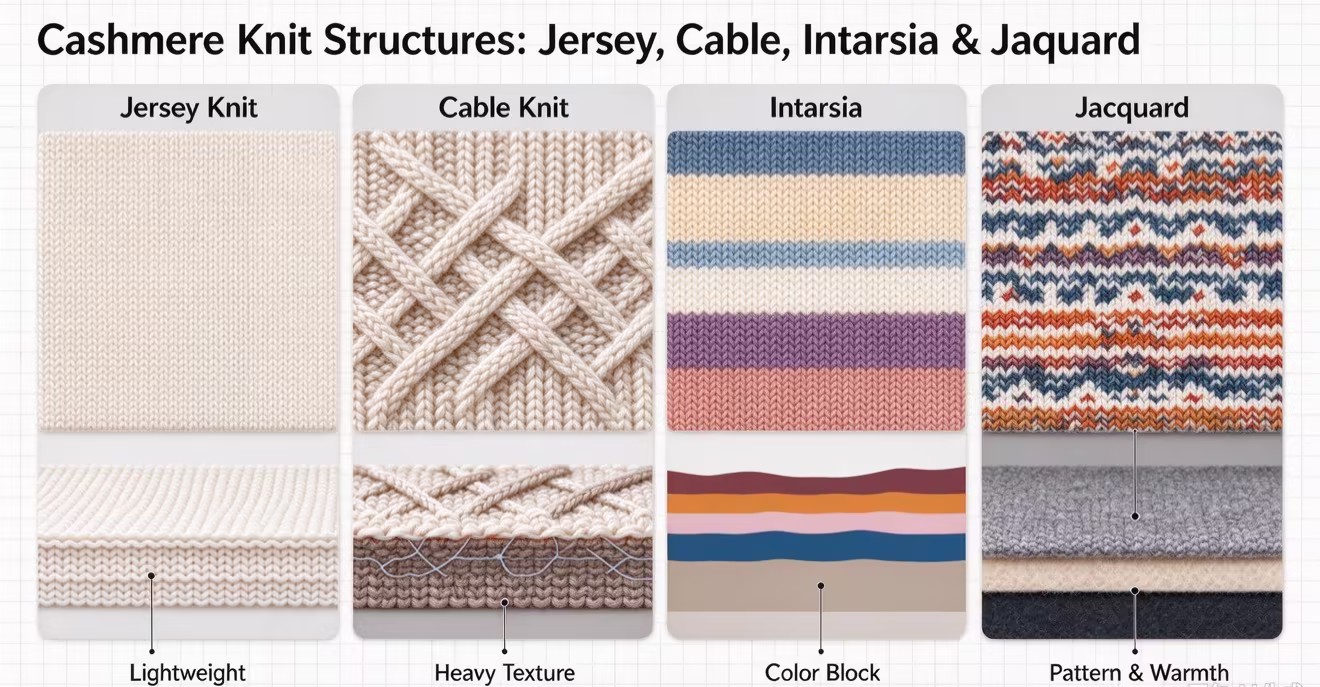
Cashmere knitting techniques influence garment texture, thickness, and appearance. Jersey knitting creates smooth, lightweight sweaters, while cable knitting adds texture and warmth. Intarsia supports distinctive color-blocked designs, and jacquard enables complex repeating patterns. Selecting the appropriate structure helps balance design complexity, comfort, and manufacturing efficiency.
![内蒙古毛衣1-1.jpg]()
Logo and Branding Integration
Custom cashmere sweater branding can include embroidery, woven labels, care tags, engraved buttons, and decorative accessories. Embroidery requires suitable stabilizers and careful needle settings to protect delicate knit fabrics. Consistent branding specifications help manufacturers maintain garment quality and create a recognizable luxury product identity.
How to Screen and Select Sweater Factories
Choosing a reliable cashmere sweater manufacturer requires evaluating material sourcing, production capabilities, minimum order quantities, quality control, and communication. Buyers should compare factory experience, available knitting equipment, previous samples, and customization services to identify suppliers capable of meeting their design and production requirements.
Solution Categories
Brands can find custom sweater manufacturers through B2B sourcing platforms, textile trade shows, and established knitwear production regions. Platforms such as Alibaba offer broad supplier access, while trade shows allow direct material inspection. Buyers should verify manufacturing capabilities, supplier credentials, and relevant production experience before selecting a partner.
Assessing Minimum Order Quantities (MOQs) & "No MOQ" Claims
Cashmere sweater MOQs vary according to yarn availability, design complexity, and factory capacity. Stock-yarn orders may support smaller quantities, while custom colors and complex designs usually require higher minimums. Buyers should clarify whether low-MOQ offers involve genuine custom manufacturing or modifications to existing garment styles.
Evaluating Factory Capabilities
A reliable cashmere knitwear factory should have suitable knitting machines, experienced technicians, and established finishing processes. Machine gauges determine fabric thickness, with lower gauges supporting chunky knits and higher gauges producing finer garments. Buyers should also assess capabilities in linking, washing, embroidery, and sample development.
Red Flags to Avoid
When selecting a cashmere sweater supplier, watch for unclear yarn sourcing, inconsistent quotations, poor communication, and limited manufacturing documentation. Suppliers unwilling to provide samples, material specifications, or reasonable inspection arrangements may present higher production risks. Transparent pricing and verifiable factory capabilities are important indicators of reliability.
Full Steps to Place Your Custom Sweater Order
The custom cashmere sweater manufacturing process typically includes technical specification development, material selection, sampling, pre-production approval, and bulk manufacturing. Establishing clear requirements at each stage helps reduce misunderstandings, maintain product consistency, and minimize costly revisions.
Developing a Comprehensive Tech Pack
A detailed cashmere sweater tech pack should include garment sketches, measurement charts, yarn composition, fiber specifications, knitting gauge, stitch patterns, and branding requirements. A complete Bill of Materials (BOM) should identify labels, buttons, trims, and other accessories. Clear documentation helps manufacturers provide accurate quotations and production samples.
The Prototyping and Sampling Phase
Cashmere sweater sampling allows brands to evaluate fit, fabric quality, knitting patterns, and construction before bulk production. Sampling time depends on yarn availability and customization complexity, with stock-yarn designs generally requiring less preparation. Buyers should confirm sample costs, revision policies, and expected lead times with the manufacturer.
Iterating and Approving the Pre-Production Sample (PPS)
Pre-production sample (PPS) approval confirms that the sweater meets design and quality expectations before manufacturing begins. Buyers should inspect garment measurements, fit, weight, stitching, color consistency, and washing performance. The approved sample serves as the reference standard for bulk production and final quality inspections.
Production, Quality Control, and Logistics
Cashmere sweater bulk production requires coordinated quality inspections, manufacturing schedules, payment arrangements, and shipping plans. Effective production management helps ensure finished garments match approved samples while reducing delays, unexpected costs, and product defects.
Establishing Quality Control (QC) Checkpoints
Cashmere sweater quality control includes inspections for fiber composition, garment measurements, stitching, pilling resistance, colorfastness, and fabric weight. Buyers may use AQL-based inspections and relevant textile testing methods to evaluate batch consistency. Final products should be checked against approved pre-production samples and agreed specifications.
Production Timelines
Custom cashmere sweater production lead times depend on yarn availability, order quantity, knitting complexity, and finishing requirements. Stock-yarn designs may support faster manufacturing, while custom dyeing, jacquard patterns, and specialized accessories require additional preparation. Buyers should confirm sampling and bulk production schedules before placing orders.
Payment Terms and Financial Risk Mitigation
Cashmere sweater manufacturing payment terms commonly involve an initial deposit and a remaining balance linked to agreed production or inspection milestones. Buyers should confirm payment schedules, quality requirements, refund conditions, and delivery responsibilities in writing. Secure payment methods and independent inspections can help reduce financial risks when working with new suppliers.
Shipping, Customs, and Import Duties
International cashmere sweater shipping involves selecting suitable freight methods, preparing customs documents, and confirming import duties. Air freight supports urgent or smaller shipments, while sea freight may be more economical for larger orders. Accurate HS classification, commercial invoices, and shipping terms help reduce customs delays and unexpected costs.
Conclusion
Finalize your comprehensive tech pack, ensuring all machine gauges, yarn specifications, and graded measurements are explicitly documented.
Define your target unit weight and acceptable yarn composition to establish a baseline for factory negotiations.
Reach out to a shortlist of 3 to 5 vetted factories to request their stock yarn color cards and initial sample quotes.
Order a Pre-Production Sample (PPS) from your top two factory choices to physically compare their knitting tension and linking quality.
FAQ
Q: What is the standard MOQ for custom cashmere sweaters?
A: Standard MOQs vary heavily by the manufacturing model. Fully custom OEM bulk factories typically require 100 to 300 units per style and color. Smaller-batch ODM suppliers utilizing stock yarn can often accommodate MOQs as low as 50 units per colorway.
Q: Can I order custom cashmere sweaters with "No MOQ"?
A: Yes, but with caveats. Factories offering "No MOQ" usually achieve this by using pre-made blanks and simply adding custom embroidery, or by utilizing leftover stock yarn from previous runs. True custom silhouettes built from scratch always require a minimum order quantity.
Q: What is the best grade of cashmere for sweaters?
A: Grade A cashmere serves as the industry standard for luxury sweaters. It features fibers longer than 34mm and a diameter of less than 15.5 microns. This specific grading ensures the sweater feels incredibly soft against the skin while remaining highly resistant to pilling.
Q: Why is a tech pack necessary for knitwear?
A: A tech pack acts as the blueprint and contract for your garment. Without it, factories will guess critical details like machine gauge, yarn tension, and specific measurements. This leads to inaccurate samples, wasted time, and costly production errors on the factory floor.
Q: How long does the sampling process take?
A: If you use factory stock yarn and standard colors, a sample takes 1 to 2 weeks to produce. If your design requires custom-dyed yarn or complex, proprietary knitting programs, sampling typically extends to 3 to 4 weeks.
Q: Should I use stock yarn or custom-dyed yarn?
A: For initial launches and low MOQs, stock yarn is highly recommended to avoid the massive minimums required by dye houses. Custom-dyed yarn is only necessary if you require exact Pantone color matching and have the volume to support 100kg+ yarn minimums.