




- Home
-
-


How to Order Cashmere Scarves Directly from a Manufacturer?
Views: 0 Author: Site Editor Publish Time: 2026-10-14 Origin: Site


Bypassing wholesalers to source directly from the factory offers immense financial advantages. You gain total control over your brand and eliminate intermediary markups. This allows you to dictate exact product specifications. However, direct procurement carries high stakes. You face the constant threat of counterfeit fibers. Inconsistent grading can ruin a production run. Communication barriers often lead to costly mistakes. Large Minimum Order Quantities (MOQs) tie up vital capital.
You need a systematic evaluation and procurement framework. This approach helps you find, vet, and verify legitimate suppliers. It removes the guesswork from overseas production. You can establish a secure and scalable supply chain. Master the technical specifications of raw materials first. Then apply advanced search tactics to uncover hidden factory websites. This guide provides the exact steps to successfully order a cashmere scarf directly from the source.
Technical Verification is Non-Negotiable: Validating a cashmere scarf manufacturer requires strict assessment of fiber length, micron count (Grade A vs. B), ply, and gauge.
Advanced Sourcing Tactics Save Time: Utilizing Boolean search and advanced search operators helps buyers bypass wholesale directories and identify true factory websites.
Certifications Mitigate Risk: Partnering with manufacturers holding Sustainable Fibre Alliance (SFA), OEKO-TEX, or Good Cashmere Standard (GCS) certifications ensures ethical sourcing and chemical compliance.
Sampling Precedes Scale: Never commit to production MOQs without a rigorous prototyping phase, including independent lab testing or physical fiber assessments (e.g., the burn test).
Total Landed Cost Matters: Unit price is only one factor; buyers must account for import duties, freight costs, and third-party Quality Control (QC) inspections when calculating ROI.
Table of Contents
Reasons to Buy Cashmere Scarves Directly from Makers
Buying directly from a cashmere scarf manufacturer offers advantages in pricing, customization, and supply chain transparency. For fashion brands and wholesale buyers, factory-direct sourcing can reduce unnecessary costs while providing greater control over product development and manufacturing quality.
1. Competitive Factory-Direct Pricing
Factory-direct cashmere scarf sourcing can reduce intermediary markups and improve wholesale pricing transparency. Buyers can communicate directly with manufacturers about yarn costs, order quantities, and production requirements. This helps brands manage purchasing budgets, negotiate competitive prices, and maintain healthier profit margins.
Explore our wholesale cashmere scarf collection for different styles and bulk ordering options.
2. Greater Customization and Brand Control
Working directly with a manufacturer provides more flexibility in custom cashmere scarf production, including yarn composition, Pantone colors, dimensions, weaving patterns, embroidery, and private labeling. Brands can communicate technical requirements directly, review samples, and refine designs before bulk manufacturing.
Discover our cashmere customization services to learn more about material selection, sampling, and production processes.
3. Better Supply Chain Transparency and Quality Control
Direct manufacturer relationships improve communication about material sourcing, production processes, and quality inspections. Buyers can request fiber composition reports, review manufacturing procedures, and verify relevant certifications. Greater transparency helps reduce sourcing risks, maintain consistent product quality, and support responsible procurement.
Review our certifications and quality credentials for additional information about manufacturing standards.
Factory-Direct vs. Trading Company Sourcing
Factor
Factory-Direct Sourcing
Trading Company Sourcing
Pricing
Direct manufacturer quotations
May include intermediary margins
Customization
Direct communication on specifications
Requirements communicated through an intermediary
Sampling
Direct feedback to production team
Feedback may pass through multiple parties
Quality Control
Direct access to production information
Depends on supplier relationships
Supply Chain Transparency
Easier to request factory-level information
May involve multiple suppliers
Communication
Direct technical discussions
Additional coordination may be required
For brands seeking custom cashmere scarves, working directly with a qualified manufacturer can simplify product development, improve cost visibility, and establish a more consistent long-term supply relationship.
Check Cashmere Quality: Core Technical Standards
Understanding Cashmere Grades (A, B, and C)
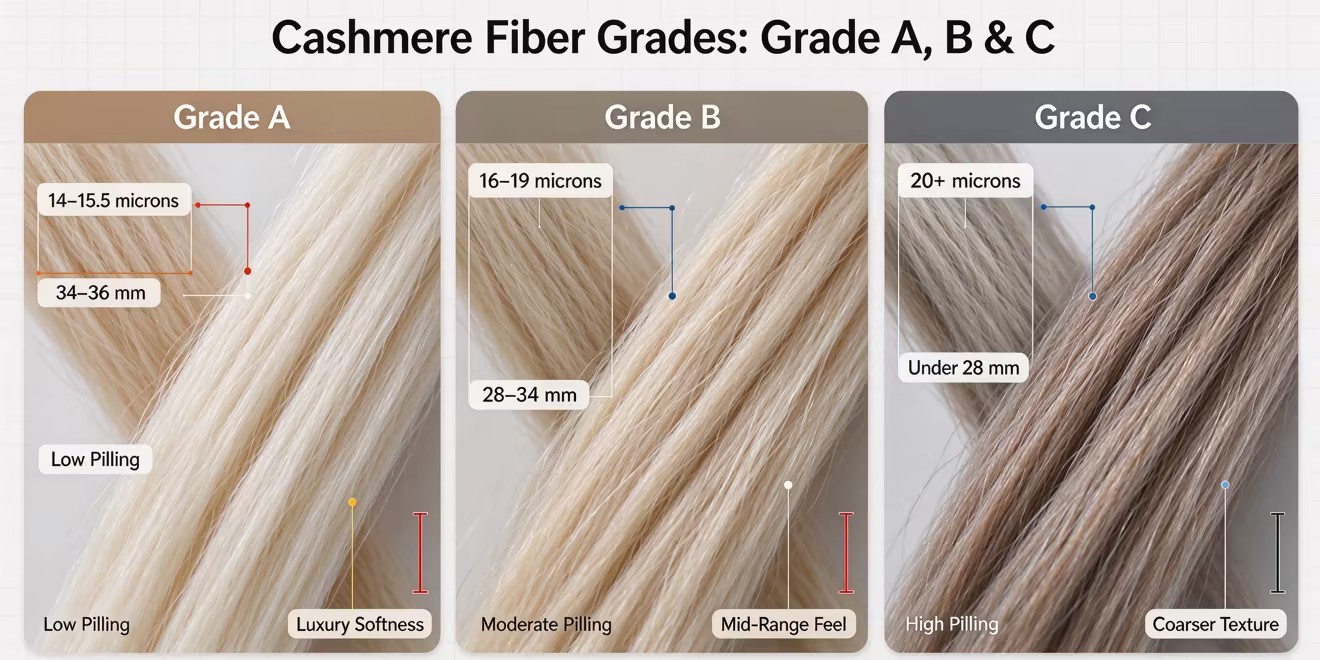
Not all raw materials perform the same on the production line. You must understand the grading system to ensure product longevity. Grade A cashmere represents the highest quality fiber available globally. These fibers measure between 14 and 15.5 microns in diameter. They reach 34 to 36 millimeters in length. This extreme length and fineness are essential for durability. Grade A fibers prevent excessive pilling and maintain a luxurious hand-feel after multiple washes.
Grade B and C fibers offer a lower-cost alternative but compromise the integrity of the final product. Grade B fibers are thicker, usually around 19 microns, and shorter. Grade C fibers are even thicker and much shorter, often salvaged from secondary shearings. Shorter fibers break easily during daily wear. This breakage leads to immediate and severe pilling on the fabric surface. The hand-feel of Grade C feels rougher and less refined. Using lower grades damages customer satisfaction and increases retail return rates.
Ply, Gauge, and Weight: What They Mean for Your Product
Cashmere ply, gauge, and fabric weight directly affect scarf warmth, texture, durability, and drape. Single-ply yarn suits lightweight scarves, while 2-ply and multi-ply yarns provide greater structure and warmth. Higher knitting gauges create finer fabrics, while lower gauges produce chunkier textures. Manufacturers should match these specifications to the intended design and seasonal application.
Blends vs. 100% Cashmere: Cost and Compliance Trade-offs
100% cashmere scarves offer premium softness and warmth but involve higher material costs. Cashmere blends with silk or merino wool can improve drape, durability, and cost efficiency. Brands must accurately declare fiber composition on product labels and comply with applicable textile labeling regulations, including relevant FTC requirements in the US market.
How to Search for Real Cashmere Scarf Factories
Advanced Search and Boolean Tactics
Advanced Google search techniques help buyers identify genuine cashmere scarf manufacturers and reduce irrelevant supplier results. Combining specific keywords such as "cashmere scarf manufacturer," "factory audit," and "weaving mill" can uncover specialized producers. Boolean operators and targeted search phrases improve sourcing efficiency, although factory credentials still require verification.
Utilizing "inURL" Search Operators
The Google
inurl:search operator helps buyers locate independent cashmere scarf factory websites. Searches such asinurl:manufacturer "cashmere scarf" -alibaba -directorycan reduce results from large sourcing platforms and highlight potential direct suppliers. Buyers should independently confirm manufacturing capabilities before establishing partnerships.How to Vet a Cashmere Scarf Manufacturer
Choosing a reliable cashmere scarf manufacturer requires evaluating certifications, production capabilities, material sourcing, and business transparency. Factory audits, sample inspections, and supplier background checks help buyers identify suitable manufacturing partners and reduce procurement risks.
Certifications and Ethical Sourcing Standards
Responsible cashmere sourcing involves verifying animal welfare, environmental practices, and textile chemical safety. Programs such as the Sustainable Fibre Alliance (SFA) and Good Cashmere Standard (GCS) address responsible sourcing, while OEKO-TEX STANDARD 100 evaluates harmful substances in certified textile products. Buyers should verify certificate validity and scope.
Assessing Production Capabilities and Capacity
A qualified cashmere scarf factory should demonstrate suitable weaving machinery, dyeing capabilities, finishing processes, and consistent quality control. Jacquard and dobby looms support different design requirements, while sufficient production capacity helps ensure reliable delivery. Buyers should request factory demonstrations, product samples, and realistic manufacturing schedules.
Red Flags: Spotting Middlemen and Trading Companies
When sourcing factory-direct cashmere scarves, watch for unclear manufacturing locations, inconsistent company information, unverifiable factory photos, and limited technical knowledge. Suppliers unwilling to provide production evidence, material specifications, or reasonable inspection access may present higher risks. Verify business registration and payment details before placing orders.
The Step-by-Step Ordering Process
The custom cashmere scarf ordering process typically includes supplier selection, sampling, MOQ negotiation, technical specification approval, production, and quality inspection. Clear documentation and approved samples help ensure finished scarves meet design requirements while reducing manufacturing errors and unexpected costs.
Step 1: Requesting and Evaluating Samples
Cashmere scarf sampling allows buyers to evaluate fiber quality, softness, weaving consistency, dimensions, and finishing techniques before bulk production. Stock samples demonstrate general manufacturing capabilities, while custom prototypes verify specific designs and colors. Fiber composition should be confirmed through appropriate testing rather than relying on hand-feel or burn tests alone.
Step 2: Negotiating Minimum Order Quantities (MOQs) and Pricing
Cashmere scarf MOQs depend on yarn availability, customization requirements, and factory production capacity. Stock yarn colors may support smaller orders, while custom dyeing and unique designs usually require higher minimum quantities. Buyers can negotiate pilot orders, volume-based pricing, and flexible color combinations to balance initial investment and production costs.
Step 3: Submitting Tech Packs and Customization Specifications
A detailed cashmere scarf tech pack should include dimensions, fiber composition, yarn specifications, Pantone colors, weaving patterns, fringe styles, and label placement. Clear measurement tolerances and finishing requirements help manufacturers produce accurate samples and consistent bulk orders. Approved technical documents should serve as the reference throughout production.
Step 4: Quality Control (QC) and Pre-Shipment Inspections
Cashmere scarf quality control includes checking fiber composition, measurements, weaving defects, colorfastness, and finishing consistency. Third-party inspections and AQL-based sampling plans help assess bulk production against approved specifications. Buyers should establish clear defect classifications, acceptance criteria, and corrective procedures before shipment.
Shipping, Lead Time & Supply Chain Risks
International cashmere scarf sourcing requires coordinated production schedules, freight planning, customs compliance, and supplier communication. Managing these factors helps reduce delivery delays, unexpected expenses, and inventory shortages. Clear procurement agreements and contingency plans support more reliable supply chain operations.
Production Timelines and Seasonality
Custom cashmere scarf production lead times depend on material availability, design complexity, dyeing requirements, and factory capacity. Bulk manufacturing may take approximately 4–8 weeks after sample approval, while custom colors can extend schedules. Seasonal demand and raw material availability should be considered when planning product launches.
Shipping Methods, Tariffs, and Import Duties
Cashmere scarf shipping commonly involves air or sea freight, depending on order quantity, urgency, and budget. Air freight provides faster delivery, while sea freight can reduce transportation costs for larger shipments. Accurate HS classification, customs documentation, and import duty calculations help avoid clearance delays and unexpected expenses.
Overcoming Supplier CRM and Communication Pain Points
Effective supplier communication helps prevent cashmere scarf production errors and delays. Centralized procurement systems can organize tech packs, sample approvals, quality reports, and order updates. Version control ensures manufacturers follow the latest specifications, while documented communication improves coordination across international supply chains.
Mitigating Supply Chain Disruptions
Cashmere scarf supply chain risk management involves maintaining reliable supplier relationships, planning inventory buffers, and establishing contingency options. Dual sourcing can reduce dependence on a single manufacturer, while clear contracts define delivery expectations and quality responsibilities. Regular production monitoring helps identify potential disruptions before they affect customer orders.
Conclusion
Finalize your technical specifications and complete a comprehensive tech pack including dimensions, ply, gauge, and Pantone codes.
Calculate your target landed cost by factoring in raw materials, manufacturing, freight, and import duties based on the correct HS code.
Shortlist three to five certified factories using advanced Boolean search operators to bypass wholesale aggregators.
Request stock samples and mandate independent lab tests to verify fiber length, micron count, and composition.
Schedule a third-party pre-shipment inspection using AQL standards before paying the final invoice balance.
FAQ
Q: What is a standard MOQ for a cashmere scarf manufacturer?
A: Standard MOQs depend entirely on the yarn selection. Stock yarn MOQs are typically low, ranging from 50 to 100 pieces per color. Custom-dyed yarn MOQs are much higher, often requiring 300 or more pieces per color to justify the industrial dyeing vat operation and setup time.
Q: How can I find a direct manufacturer instead of a trading company online?
A: Use advanced search operators like `inurl:manufacturer` and Boolean search strings to bypass wholesale directories. Always request official factory audit reports, ISO certifications, and live video tours of the weaving looms to verify their actual physical production capabilities.
Q: How can I verify a manufacturer uses 100% authentic cashmere?
A: You must demand independent lab testing before bulk production begins. Send a pre-production sample to a certified facility like SGS or Intertek. They will test for exact micron count and perform microscopic fiber identification to ensure no synthetic or wool fillers are present.
Q: How long does it take to manufacture a custom cashmere scarf?
A: The timeline is split into two distinct phases. Sampling typically takes 1 to 2 weeks. Once the prototype is approved, bulk production requires 4 to 6 weeks. Always add extra time for custom dyeing, lab dips, and international freight transit.
Q: What is the difference between a manufacturer and a trading company?
A: Manufacturers own the physical production facilities, including the looms, spinning machines, and dyeing equipment. Trading companies act as intermediaries. They source goods from manufacturers and add a markup to the unit price, reducing your overall profit margins and limiting transparency.
Q: Are there import duties on cashmere scarves?
A: Yes, import duties apply and vary significantly by the country of origin and the destination country. Buyers must check specific HS codes for textiles with a licensed customs broker to accurately calculate their total landed costs and avoid border delays.
Q: What is Grade A cashmere?
A: Grade A is defined by strict technical metrics. The fibers must measure between 14 and 15.5 microns in diameter and be over 34mm in length. This specific profile ensures maximum softness, high tensile strength, and prevents excessive pilling during wear.


