The global luxury knitwear market is expanding rapidly. Volatile raw material costs and the commoditization of luxury fibers force retailers to scrutinize their fabric sourcing strategies. Retail buyers must balance consumer demand for premium, ultra-soft garments against strict margin requirements, price elasticity, and the high return rates associated with delicate fabrics. To optimize inventory and protect brand reputation, retailers must systematically evaluate the technical, financial, and marketing trade-offs between stocking pure Cashmere and strategic blends. You need a clear path to navigate these material choices effectively. We will break down the exact performance metrics, compliance standards, and merchandising tactics required to build a profitable knitwear assortment. Understanding fiber performance directly impacts your bottom line.
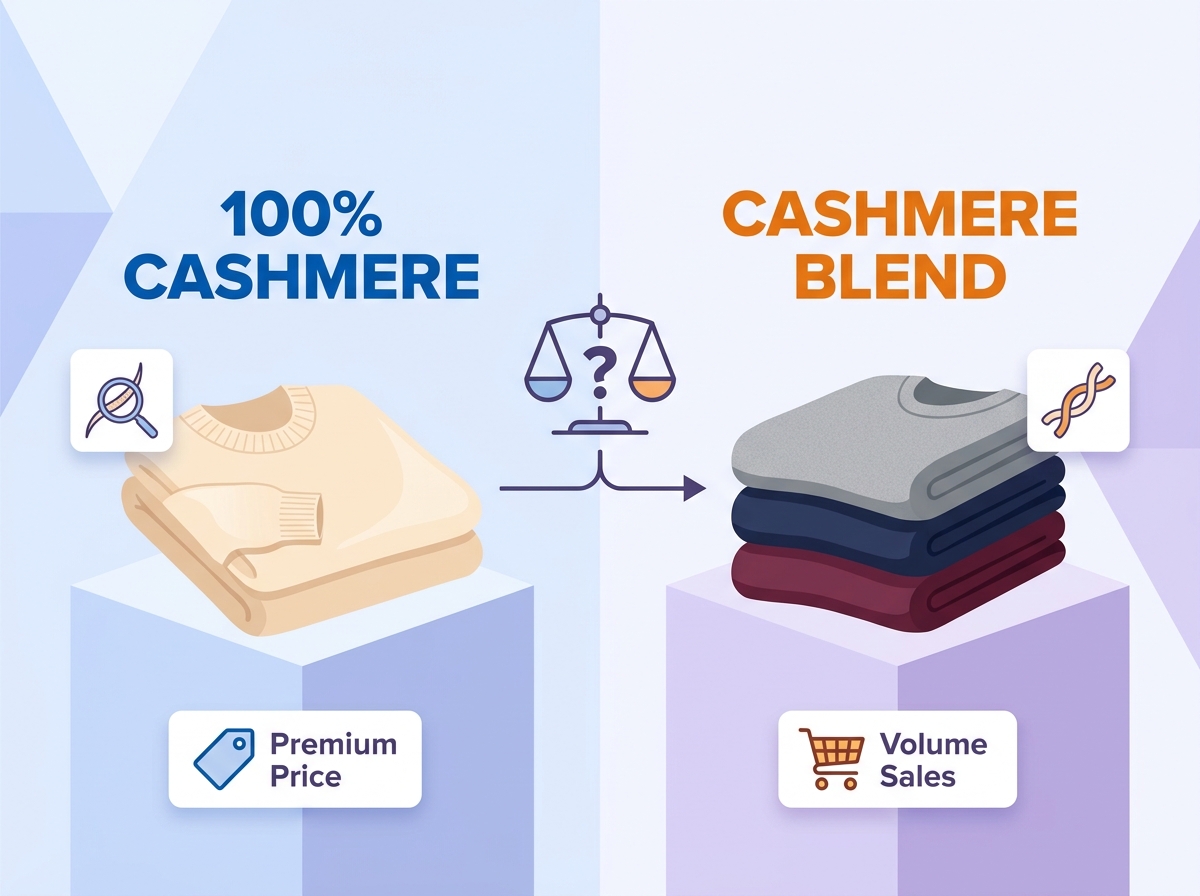
Margin vs. Volume: 100% cashmere commands premium pricing and higher per-unit margins, while cashmere blends drive higher sales velocity through accessible price points and easier maintenance.
Durability and Returns: Blends incorporating merino wool or silk significantly reduce pilling and shape-loss, directly lowering customer return rates and post-purchase dissatisfaction.
Market Positioning: Retailers must actively differentiate their high-quality cashmere from fast-fashion alternatives, educating consumers on the engineered benefits of blends versus low-grade pure fibers.
Compliance Risks: Marketing a garment as "cashmere" requires strict adherence to FTC and international textile labeling laws; deceptive marketing of low-percentage blends (e.g., 5%) damages brand trust.
Assortment Strategy: The most resilient retail strategy utilizes a tiered approach, leveraging blends for transitional seasons and pure cashmere for peak winter luxury collections.
Table of Contents
Toggle
How Retailers Can Build a Profitable Cashmere Knitwear Assortment
Defining Target Demographics and Price Elasticity
Understanding your core demographic is the first step in formulating a profitable knitwear strategy. Retailers must assess their customers' willingness to pay a premium for pure luxury against their demand for everyday utility and easier maintenance. Consumers shopping at high-end boutiques expect uncompromised quality and are prepared for the delicate care routines required by pure fibers. Conversely, shoppers in mid-tier retail environments prioritize longevity, ease of care, and accessible luxury.
Mapping price ceilings for knitwear categories within your specific retail environment prevents inventory stagnation. Procurement teams must analyze historical sales data to identify the exact price points where consumer resistance begins. If your data indicates strong resistance above a certain threshold, forcing pure luxury knits into the assortment will likely result in heavy end-of-season markdowns. Strategic blending allows merchandisers to engineer garments that hit precise target margins while maintaining the tactile appeal necessary for high conversion rates on the sales floor. You must segment your customer profiles accurately to align fabric choices with their actual spending habits.
Navigating Fast-Fashion Commoditization
The market is currently saturated with low-cost, fast-fashion alternatives that dilute the perceived value of luxury knits. These mass-market garments typically utilize short-staple fibers, which are prone to rapid pilling, shedding, and structural failure after minimal wear. Retailers must actively address this commoditization by establishing rigorous sourcing standards that differentiate their premium inventory from inferior offerings. You cannot compete on price with fast fashion; you must compete on structural integrity and longevity.
Educating the consumer at the point of sale becomes a critical operational requirement. Visual merchandising, detailed hangtags, and knowledgeable sales staff must communicate the differences in fiber length, tension, and yarn ply. By highlighting the structural integrity of your sourced garments, you insulate your brand from the race-to-the-bottom pricing models prevalent in the fast-fashion sector. Implement macro-photography on your product displays to visually demonstrate the tight yarn twist and superior finish of your premium knits compared to loosely woven mass-market alternatives.
Margin Expectations vs. Sourcing Costs
Procurement teams must continuously analyze the wholesale cost of raw materials. The grading system dictates both the upfront cost and the garment's ultimate lifespan. Grade A fibers, measuring between 14 and 15.5 microns in diameter and over 34 millimeters in length, yield superior softness and durability but command the highest wholesale costs. Grade B and C fibers are thicker and shorter, reducing initial costs but drastically increasing the likelihood of pilling and customer returns.
Calculating total landed costs requires looking beyond the invoice price of the garments. Pure luxury goods demand specialized logistics to prevent inventory shrinkage. You must factor in the costs of climate-controlled freight, rigorous pest management protocols in your warehouses, and higher insurance premiums for transporting high-value natural fibers. Blended alternatives often mitigate these hidden logistical expenses, offering a more predictable and stable supply chain. When you calculate your initial markups, ensure you are accounting for the entire lifecycle expense of managing delicate inventory.
100% Cashmere: Benefits, Risks, and Retail Positioning
Characteristics and Consumer Perception
Pure luxury knits offer an unmatched warmth-to-weight ratio and a distinctively soft hand-feel that synthetic alternatives cannot replicate. The physical structure of the fiber, characterized by its fine micron count and unique natural crimp, traps insulating air while remaining incredibly lightweight. This tactile superiority creates an immediate brand association with high-end luxury and exclusivity. When a customer touches a pure Grade A knit, the physical feedback instantly justifies a premium retail positioning.When a customer touches a pure Grade A knit—such as Lanly Cashmere’s 100% Mongolia cashmere collection—the physical feedback instantly justifies a premium retail positioning.
The psychological impact of a pure content label heavily influences consumer purchasing behavior. For a specific segment of the market, the label itself acts as a status symbol, validating the purchase and elevating the perceived prestige of the retailer. This perception allows brands to cultivate a loyal customer base that prioritizes authentic material composition over practical durability. You can leverage this psychological trigger to build a dedicated clientele that returns season after season for your flagship knitwear pieces.
Retail Advantages
Stocking pure, unblended knits provides retailers with the ability to anchor premium pricing tiers. These flagship products elevate the entire store assortment, creating a halo effect that can increase the perceived value of adjacent, lower-tier merchandise. Justifying premium retail positioning requires flawless execution in product design, store presentation, and customer service. When you place a pure luxury knit at the front of your store, it sets the tone for the entire shopping experience.
These garments hold exceptionally high appeal during peak gifting seasons, particularly in the fourth quarter. Shoppers looking for high-impact, luxurious gifts gravitate toward pure natural fibers. Positioning these items prominently during the holiday rush can significantly boost average transaction values and drive substantial revenue spikes. You should allocate a larger portion of your open-to-buy budget to pure knits specifically for the November and December selling periods to capture this high-margin gifting traffic.
Implementation Risks and Mitigation
Inventory shrinkage is a severe risk when dealing with pure animal fibers. These garments are highly susceptible to moth damage during warehouse storage and transit. Retailers must invest in climate-controlled, pest-managed logistics facilities. Regular inventory audits and specialized packaging are necessary operational safeguards. You cannot store pure knits in standard cardboard boxes in a damp warehouse; they require airtight garment covers, cedar-infused storage solutions, and strict humidity monitoring.
Customer returns present another significant challenge. Pure, short-staple knits are inherently prone to pilling under friction and require high-maintenance care routines. Retailers can mitigate post-purchase dissatisfaction through proactive customer education. Including complimentary fabric combs, detailed care guides, and clear instructions on proper washing and storage directly inside the packaging helps manage consumer expectations and reduces return rates. Train your customer service teams to handle pilling complaints by educating the buyer on natural fiber shedding rather than immediately issuing a refund.
Cashmere Blends: Types, Benefits, and Best Retail Uses
Wool and Merino Blends (Structure and Resilience)
Integrating merino wool into the yarn composition fundamentally alters the garment's structural integrity. Merino fibers possess a natural elasticity and a more pronounced scale structure, which enhances garment memory and prevents sagging over time. This combination retains a soft hand-feel while significantly increasing durability against daily friction. When a customer wears a merino blend under a heavy winter coat, the fabric resists the abrasive friction that would normally destroy a pure, delicate knit.
These blends are ideal for everyday wear, successfully reducing the friction of customer care requirements. Tactile testing reveals distinct differences across various ratios. A standard 70/30 merino blend offers robust structure with a hint of luxury softness. Complex tri-blends, incorporating elements like silk alongside merino, create a highly engineered fabric that balances tensile strength, drape, and exceptional tactile feedback. You should request physical samples of multiple ratios from your suppliers to conduct blind hand-feel tests with your merchandising team before committing to a production run.
Silk Blends (Luster, Drape, and Transitional Wear)
Silk is a continuous filament fiber renowned for its incredible tensile strength. When blended with fine animal fibers, silk acts as a structural backbone, preventing the garment from losing its shape or stretching out at the elbows and hem. Furthermore, silk adds a premium, subtle sheen to the fabric, elevating the visual appeal of the knitwear. This structural reinforcement is critical for lightweight cardigans and fine-gauge sweaters that are prone to distortion on the hanger.
This specific combination positions exceptionally well for early fall or spring collections. Silk possesses natural temperature regulation properties, making the resulting garments highly breathable and suitable for transitional weather. Retailers can leverage these lightweight knits to maintain sales momentum during periods when heavy winter apparel begins to stagnate on the floor. By shifting your assortment to silk blends in February and March, you keep your knitwear department profitable year-round without relying on heavy markdowns.
Cotton and Bamboo Blends (Accessibility and Breathability)
Blending with cotton or bamboo drives down wholesale costs significantly while maintaining a luxury association in the consumer's mind. Cotton provides a familiar, easy-care profile that appeals to shoppers seeking low-maintenance wardrobes. These garments can often withstand gentle machine washing, removing a major barrier to purchase for convenience-driven demographics. When a customer sees a machine-washable tag on a luxury-adjacent garment, their hesitation to purchase drops dramatically.
Bamboo blends appeal directly to eco-conscious consumers looking for sustainable alternatives. Bamboo fibers are naturally breathable, moisture-wicking, and possess a smooth texture that complements luxury yarns. This category allows retailers to offer year-round stocking options, ensuring that knitwear remains a viable revenue stream even during the warmer summer months. You can merchandise bamboo blends alongside lightweight linen trousers and summer dresses to create cohesive, warm-weather luxury outfits.
Cashmere vs. Cashmere Blends: Durability, Sourcing, and Care
Durability and Lifecycle Cost
Evaluating the technical specifications of yarn is crucial for predicting retail outcomes. Pure, delicate fibers have lower tensile strength and abrasion resistance compared to engineered blends. When subjected to the friction of seatbelts, desk edges, or outerwear linings, pure knits will inevitably pill and degrade faster than a robust 70/30 merino combination. You must review the Martindale abrasion test results provided by your textile mills to understand exactly how a fabric will perform under real-world conditions.
Fabric durability directly correlates with historical return rates and customer lifetime value. A customer who purchases a highly durable blend that maintains its shape and appearance after multiple washes is far more likely to return for repeat purchases. Conversely, a high-priced pure garment that deteriorates rapidly can permanently damage brand trust and erode long-term profitability. Your merchandising strategy must prioritize fabrics that survive the customer's daily routine, not just fabrics that feel soft on the display table.
Supply Chain and Sourcing Scalability
The global supply of raw luxury fibers is inherently volatile, subject to environmental factors, desertification in grazing regions, and geopolitical trade shifts. Relying solely on pure yarns exposes retailers to significant supply chain risks and sudden wholesale cost spikes. Severe winters in key agricultural regions can decimate herds, leading to immediate raw material shortages. Evaluating the availability of these materials during such shortages is a critical risk management exercise for any procurement director.
Blended yarns offer a much more stable supply chain. Vendor reliability increases when sourcing blends, as the raw materials are more abundant and less susceptible to localized agricultural crises. Furthermore, blends often provide greater consistency in dye lots across different fiber combinations, ensuring that color matching remains accurate across large production runs and multiple retail locations. When you build your assortment around stable blends, you protect your margins from unpredictable agricultural fluctuations.
Care Requirements as a Conversion Factor
The modern consumer is highly convenience-driven, and care labels heavily influence purchasing decisions at the fitting room stage. "Dry Clean Only" or "Hand Wash" labels create immediate friction, often causing shoppers to abandon the purchase. The ongoing cost and effort associated with professional garment care are significant deterrents for everyday apparel. You lose a measurable percentage of sales every time a customer checks a restrictive care tag.
Positioning blends as the superior choice for buyers seeking low-maintenance luxury is a highly effective conversion strategy. By engineering garments that can withstand delicate machine cycles, retailers remove the post-purchase burden from the consumer. Marketing this specific technical feature transforms a potential objection into a strong selling point. Train your sales staff to actively point out the easy-care instructions on blended garments to close sales with hesitant buyers.
Compliance and Marketing: Navigating Labeling Laws and Consumer Trust
Legal Requirements for Textile Labeling
Marketing a garment requires strict adherence to the Wool Products Labeling Act and equivalent international labeling laws. The Federal Trade Commission mandates that the exact percentages of all fibers must be clearly stated on the physical tag, listed in order of predominance by weight. Retailers cannot legally use specific luxury fiber names on tags or marketing materials if the garment does not meet stringent definitions regarding fiber diameter and origin. You must audit your factory's labeling practices to ensure absolute compliance before any product hits the sales floor.
Furthermore, labeling laws differentiate between virgin and recycled fibers. If a garment utilizes post-consumer or post-industrial recycled yarns, this must be explicitly disclosed on the care tag. Failure to comply with these regulations invites severe financial penalties, product recalls, and devastating public relations crises that can permanently tarnish a retailer's reputation. Your legal and compliance teams must review every single product description and physical hangtag for accuracy.
Overcoming the "Cheap Cashmere" Misconception
A common consumer misconception is that blends are merely a cost-cutting measure designed to offer a diluted version of pure luxury. Retailers must actively combat this narrative through strategic consumer education. Sales teams and marketing copy must pivot the conversation away from cost reduction and focus entirely on structural engineering. You need to control the narrative before the customer assumes the blend is inferior.
Educating consumers that blends are purposefully designed for durability, shape retention, and ease of care reframes the product's value proposition. When a customer understands that merino wool is added to prevent the sweater from sagging, or that silk is added to increase tensile strength, they view the blend as a technical upgrade rather than a financial compromise. Update your e-commerce product descriptions to explain exactly why each fiber was chosen for the blend.
Marketing Fabric Content Effectively
Effective marketing requires tailoring the message to the specific fabric composition. For accessible blends, marketing campaigns should highlight structural benefits, longevity, and everyday utility. Emphasize how the garment fits seamlessly into a busy lifestyle without requiring constant maintenance or professional dry cleaning. Show the garment being worn in active, everyday scenarios to reinforce its durability.
Conversely, marketing pure knits requires a focus on heritage, tactile supremacy, and exclusivity. The narrative should center on the sourcing journey, the rarity of the raw materials, and the traditional craftsmanship involved in the knitting process. Distinct marketing strategies for each tier prevent cannibalization within your own assortment. You must ensure your marketing team understands the distinct value propositions of pure fibers versus engineered blends.
Avoiding Greenwashing and Misleading Claims
The reputational risk of deceptive marketing is immense. Highlighting a luxury fiber in product titles or social media campaigns when the garment contains a negligible amount is a fast track to losing consumer trust. Modern shoppers are highly educated, frequently check composition tags, and will publicly call out brands that engage in misleading practices. Do not attempt to trick your customer base with clever naming conventions.
Best practices for transparent marketing dictate that product names should accurately reflect the dominant fibers. If a sweater is 90% cotton and 10% luxury fiber, it should be marketed as a "Cotton Blend," not heavily promoted on the back of the minor luxury component. Aligning marketing claims with strict E-E-A-T principles ensures long-term brand credibility. You build trust by being radically transparent about your fabric sourcing and composition.
How to Balance 100% Cashmere and Blends in Your Assortment
The "Good, Better, Best" Merchandising Strategy
The most resilient retail strategy utilizes a tiered merchandising approach, structuring inventory to capture multiple market segments simultaneously. This "Good, Better, Best" model allows retailers to serve price-sensitive shoppers while still catering to high-net-worth individuals seeking absolute luxury. You can maximize your floor space by offering a clear progression of quality and price.
Tier
Fabric Composition
Primary Retail Benefit
Target Consumer
Good
Cotton or Bamboo Blends
High volume, low wholesale cost, easy care
Price-sensitive, convenience-driven shoppers
Better
Merino or Silk Blends
Optimal balance of durability, margin, and luxury feel
Everyday professionals seeking resilient quality
Best
100% Grade-A Pure Fiber
Maximum prestige, high per-unit margin, halo effect
Luxury buyers, Q4 gift shoppers
Implementing this structure requires precise visual merchandising. The "Best" tier should be displayed prominently in high-traffic focal points to draw customers in, while the "Better" and "Good" tiers should be merchandised by color and style to encourage volume purchasing and wardrobe building. For retailers looking to curate their "Best" tier with modern minimalist designs, explore Lanly Cashmere for premium 100% pure knitwear inspiration.
Seasonal Inventory Shifts
Timing the introduction of specific fabric weights is critical for maximizing inventory turnover. Heavy, pure knits should be strategically held back and introduced just prior to Q4. This timing aligns perfectly with dropping temperatures and the onset of the holiday gifting season, maximizing the potential for full-margin sell-through. Do not waste floor space on heavy pure knits in August; keep them warehoused until the weather turns.
As the retail calendar shifts into Q1 and Q2, inventory must pivot aggressively toward lightweight silk and cotton blends. These transitional pieces maintain knitwear revenue during warmer months without looking out of place on the sales floor. Proper seasonal phasing prevents capital from being tied up in heavy winter stock during the spring markdown period. You must work closely with your supply chain managers to ensure these lightweight blends arrive exactly as the heavy knits are being phased out.
Conclusion
Audit your historical knitwear return rates to identify if pilling, shrinkage, or care complaints are driving post-purchase dissatisfaction in your current assortment.
Request physical blend samples from your suppliers to conduct blind hand-feel testing across different yarn ratios with your merchandising team.
Review all current product naming conventions, physical hangtags, and e-commerce descriptions to ensure strict compliance with FTC textile labeling laws.
Adjust your open-to-buy budget to allocate heavier pure knits strictly for Q4, shifting Q1 and Q2 capital into breathable silk or cotton blends.
Established in 2009 in Hohhot, Inner Mongolia, Inner Mongolia Field Textile Products Co., Ltd. specializes in cashmere and cashmere-blend products, with capabilities covering knitwear, scarves, shawls, accessories, and customer-specific design development. Its broad product range and location within a major cashmere and wool sourcing region provide a practical manufacturing background for retailers developing both premium pure-cashmere collections and diversified blended assortments.
FAQ
Q: What is the minimum percentage required to label a garment as a blend?
A: Under FTC regulations, there is no minimum percentage required to call a garment a blend. You must clearly list the exact percentages of all fibers on the tag in descending order of weight. Heavily marketing a garment based on a fiber that constitutes less than five percent of the total composition is deceptive and damages brand trust.
Q: Does 100% pure fiber pill more than a merino wool blend?
A: Yes. Pure luxury fibers are shorter and more delicate than merino wool. When subjected to friction, these short fibers loosen and tangle, creating pills. Blending with longer, more resilient fibers like merino wool or silk significantly increases the yarn's tensile strength and reduces the rate of pilling.
Q: How can retailers differentiate premium inventory from fast-fashion offerings?
A: Retailers must focus on consumer education at the point of sale. Highlight the use of long-staple fibers, tighter knitting tensions, and superior yarn plies. Providing detailed care instructions, transparent sourcing stories, and utilizing high-quality visual merchandising helps separate premium garments from low-grade fast-fashion alternatives.
Q: What are the FTC labeling requirements for marketing these products?
A: The FTC requires that textile labels accurately disclose the generic names and percentages by weight of the constituent fibers. The label must also state the country of origin and the identity of the manufacturer or the business handling the product. Misrepresenting fiber content is a direct violation of the law.
Q: Why do retailers stock low-percentage blends, and is it an effective strategy?
A: Retailers stock low-percentage blends to legally use premium keywords in their product descriptions while keeping wholesale costs extremely low. While effective for short-term margin gains in fast fashion, this strategy risks long-term brand degradation if consumers feel misled by the lack of actual luxury tactile feel.
Q: Which blend offers the lowest customer return rate for retail brands?
A: A 70/30 merino wool and luxury fiber blend typically yields the lowest return rates. This specific ratio provides the structural resilience and memory of merino wool, preventing sagging and excessive pilling, while retaining enough premium fiber to deliver a soft, non-itchy hand-feel.