High-quality Cashmere represents a significant upfront capital investment for apparel retailers. Misjudging consumer neckline preferences leads to stagnant inventory and margin-eroding markdowns. Buyers and merchandisers must balance stock across crew neck, V-neck, and turtleneck styles without relying on anecdotal trends. You need a rigorous analysis of historical sell-through rates, demographic appeal, and seasonal versatility.
This guide provides an evidence-based evaluation of crew neck, V-neck, and turtleneck sweaters. We analyze consumer demand, styling versatility, and inventory risk to help you optimize your knitwear assortment strategy. We strip away the guesswork and focus on what drives volume, margin, and customer retention on the sales floor.
Key Takeaways
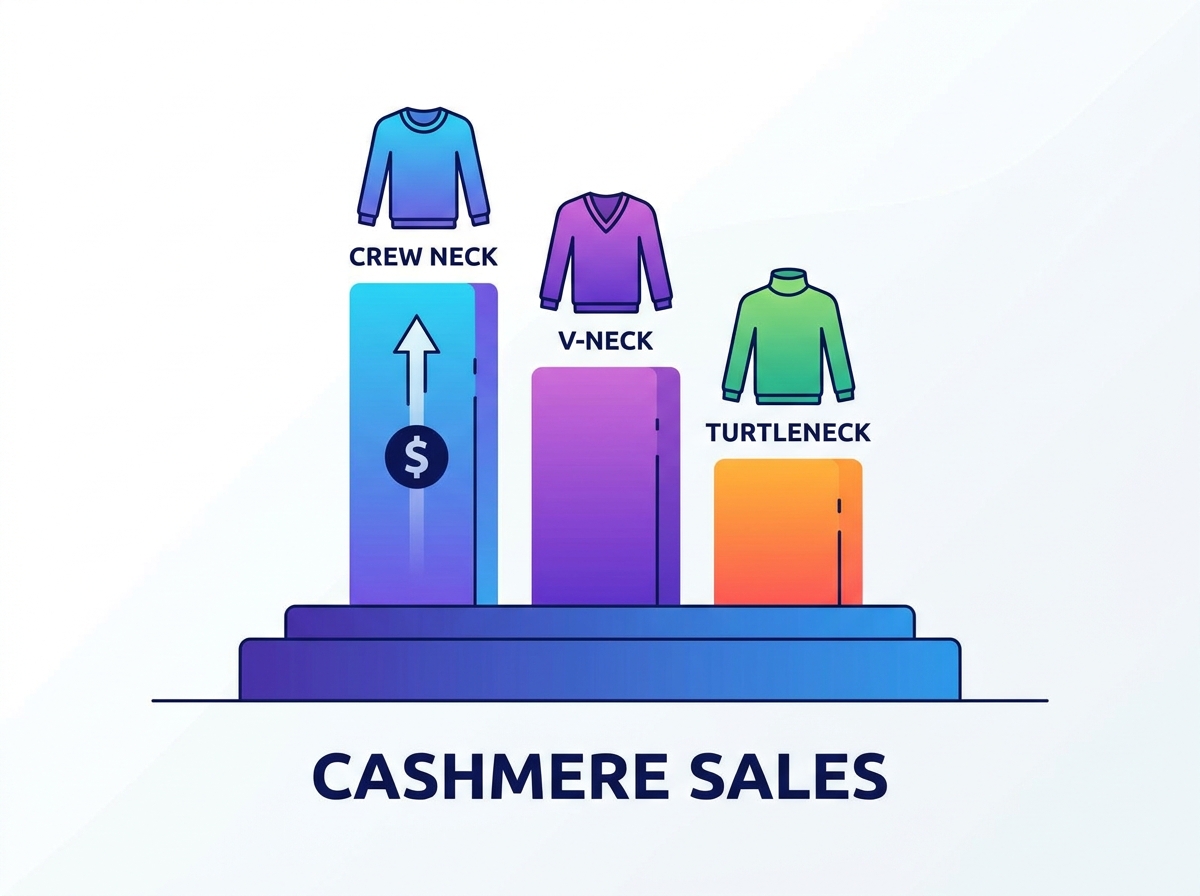
- Crew Necks Drive Volume: The crew neck remains the lowest-risk, highest-velocity SKU in cashmere assortments due to its universal demographic appeal and year-round wearability.
- V-Necks Serve a Specific Niche: V-neck demand is highly dependent on the target demographic (often skewing toward traditional corporate wear, specific men's layering needs, or slouchy trend-driven fits), requiring tighter inventory control.
- Turtlenecks Command Premium Pricing: While highly seasonal and climate-dependent, cashmere turtlenecks offer the highest perceived luxury value and "cozy luxe" aesthetic, allowing for stronger margins during peak winter months.
- The Optimal Assortment Ratio: Data suggests a baseline inventory split heavily favoring crew necks (often 50-60%), with V-necks and turtlenecks acting as specialized margin-drivers based on regional climate and customer base.
The Business Case for Optimizing Cashmere Inventory
Defining a successful knitwear SKU requires looking beyond initial aesthetic appeal on a showroom mannequin. You must measure success based on sell-through velocity, minimal return rates, and resistance to end-of-season markdowns. A poorly planned assortment traps your open-to-buy capital in slow-moving stock. When you over-index on trend-driven necklines or misjudge regional climate needs, your seasonal budget stagnates. Retailers cannot afford to let premium knitwear sit on shelves until spring clearance forces a liquidation strategy.
Evaluating each neckline requires a multi-dimensional approach. You must assess production costs, including yarn weight, staple length, and ply requirements. You must also evaluate styling versatility, which translates directly to cost-per-wear for the consumer. Demographic adoption plays a massive role in this equation. Different age groups and professional sectors gravitate toward specific necklines based on their daily lifestyle needs and workplace dress codes. A tech worker in Seattle demands a different silhouette than a corporate banker in London.
Navigating the price-point battlefield presents another major hurdle for merchandisers. The market remains sharply divided between mass-market entry-level options and premium luxury tiers. Neckline construction often justifies higher retail positioning. A poorly constructed collar sags and pills after three washes, instantly downgrading the garment's perceived value and triggering customer returns. Conversely, a meticulously linked neckline with proper tension signals durability and luxury. Retailers must align their neckline choices and technical specifications with their target market's quality expectations to maintain healthy gross margins.
Inventory optimization also impacts visual merchandising and store capacity. Heavy-gauge turtlenecks take up significantly more cubic space on a folded fixture than fine-gauge crew necks. If you allocate too much floor space to bulky seasonal items, you reduce the overall SKU density of your sales floor. Smart buyers calculate the stock-to-sales ratio for each neckline to ensure the physical store layout maximizes revenue per square foot.
Crew Neck Cashmere Sweaters: The High-Volume Staple
Consumer Demand & Sell-Through Velocity
The crew neck serves as the foundational garment in any knitwear collection. Analyze baseline demand across any major retailer, and you will find the crew neck consistently outperforms other styles. This holds true across both men's and women's categories regarding total units sold. It offers a blank canvas for consumers. The lack of complex styling requirements makes it an easy, impulsive purchase for shoppers seeking everyday luxury.
Sell-through velocity for crew necks remains steady throughout the year. Unlike heavy winter styles, a lightweight 12-gauge crew neck transitions smoothly into spring and cool summer evenings. This extended selling window drastically reduces markdown risk. Retailers can confidently commit larger open-to-buy budgets to this silhouette, knowing it will generate consistent cash flow regardless of unseasonable weather patterns.
Styling Versatility & Demographic Appeal
The crew neck adapts effortlessly across casual, smart-casual, and relaxed-corporate dress codes. Consumers wear it over a t-shirt for weekend errands or under a tailored blazer for office environments. This high cost-per-wear value makes it highly attractive to practical shoppers who calculate the utility of their wardrobe investments.
Demographic adoption is incredibly broad. Gen Z and Millennial buyers often gravitate toward slouchy, relaxed fits. They utilize oversized crew necks as statement streetwear pieces, often sizing up to achieve a specific drape. Older demographics prefer classic, tailored fits that offer timeless elegance. By simply adjusting the grade rules and silhouette in your tech packs, a single crew neck design can capture multiple market segments simultaneously.
Inventory Risks & Mitigation
The primary risk with crew necks is market over-saturation. You face intense competition from entry-level, mass-market brands offering basic styles at aggressive promotional cadences. If your product looks and feels identical to a budget alternative on the hanger, consumers will default to the cheaper option.
You must mitigate this risk through clear product differentiation. Compete on quality and technical execution. Implement these specific strategies to elevate your crew neck assortment:
- Specify Superior Yarn: Mandate Grade A, long-staple fibers (minimum 34mm length) to ensure a softer hand-feel and superior pilling resistance.
- Upgrade the Ribbing: Use a 2x2 rib construction on the collar, cuffs, and hem to provide better memory and prevent the garment from bagging out over time.
- Refine the Shoulder Construction: Implement a saddle shoulder or fully fashioned set-in sleeve to create a more tailored, premium drape across the upper body.
- Control the Milling Process: Work with your factory to perfect the washing (milling) process. Over-milling makes the sweater feel incredibly soft initially but destroys the fiber integrity, leading to immediate pilling. Find the exact balance for durability.
- Develop Proprietary Colors: Introduce unique, custom-dyed colorways that budget brands relying on stock yarn cannot replicate.
V-Neck Cashmere Sweaters: The Layering Specialist
Target Audience & Use Cases
The classic V-neck targets a specific consumer profile. Traditional corporate professionals rely on this silhouette for office environments. Buyers seek specific layering solutions, often wearing V-necks over crisp collared shirts or under structured blazers. The V-shape frames a tie or a woven collar perfectly, making it an absolute staple in classic menswear assortments.
Modern styling shifts have introduced new cross-selling opportunities on the women's side of the floor. Women's fashion frequently embraces the trend of layering slouchy, relaxed-fit V-necks over slim turtlenecks or crisp white t-shirts. This creates a textured, multi-dimensional look. Retailers can capitalize on this by merchandising these two styles together on the same fixture, driving higher units per transaction (UPT).
Fit, Flattery, and Construction Metrics
The technical requirements of a successful V-neck are strict. The depth of the "V" dictates consumer acceptance. If the drop is too deep, it limits versatility, exposes too much chest, and alienates conservative buyers. If it is too shallow, it mimics a crew neck and causes collar bunching when layered over woven shirts. Achieving the "just-right V" requires rigorous fit sessions across multiple sizes.
Consumer feedback consistently highlights the V-neck as a flattering option. The vertical line elongates the neck and draws the eye downward, creating a slimming effect across the torso. This makes it highly popular among demographics seeking tailored, figure-enhancing knitwear.
Structural integrity at the neckline is paramount. A V-neck is highly prone to sagging and losing its shape over time due to the lack of continuous collar tension. This is a common consumer complaint that drives costly returns. You must require reinforced knitting at the point of the V. Ensure your suppliers use tight ribbing and proper linking techniques to anchor the collar to the body panels securely.
Sales Seasonality & Stocking Ratios
V-neck performance peaks during transitional seasons like early fall and late spring. Consumers use them as lightweight layering pieces when temperatures fluctuate throughout the day. During deep winter, demand often shifts toward styles offering more neck coverage and thermal retention.
Formulate a conservative stocking strategy for V-necks. Because they have a narrower appeal compared to crew necks, over-purchasing leads to excess inventory. Monitor historical sales data closely and adjust your buys to reflect regional climate patterns and the professional demographics of your specific store locations.
Turtleneck Cashmere Sweaters: The Premium Seasonal Driver
Perceived Value & Pricing Power
Consumers inherently associate turtlenecks with high-end luxury. The silhouette projects elegance, sophistication, and a "cozy luxe" aesthetic. This strong emotional connection allows retailers to position turtlenecks at the top of their knitwear pricing architecture. When a customer touches a thick, plush turtleneck, they immediately perceive the intrinsic value of the garment.
The pricing elasticity of turtlenecks is highly favorable for retailers. Consumers are generally willing to pay a premium for this style. They recognize the extra material required for the extended neck. They also perceive greater warmth and elevated styling potential. This allows you to achieve stronger gross margins during peak selling periods, offsetting the lower margins often associated with highly competitive basic crew necks.
Climate Dependencies & Regional Sales Variances
Turtleneck sell-through rates correlate directly with geographic climate data. Stores in northern, colder regions will see rapid inventory turnover as soon as the first frost hits. Conversely, stocking heavy-gauge turtlenecks in mild or transitional climates is a massive inventory risk. The limited wearing window in warmer regions guarantees leftover stock and deep markdowns.
To mitigate climate risk, consider alternative constructions for southern or coastal stores. Instead of heavy, chunky 7-gauge knits, stock ultra-fine 16-gauge slim turtlenecks designed specifically as base layers. These lightweight options perform well in milder climates and appeal to consumers looking for sleek, bulk-free winter wear to layer under leather jackets or lightweight coats.
Production Costs vs. Retail Margins
Manufacturing a turtleneck costs more. The extended neck requires higher yarn consumption, which directly impacts your FOB price at the factory level. However, the higher retail price point easily absorbs this increased production cost, resulting in a net positive margin contribution to the category.
The technical challenge lies entirely in the yarn selection and micron count. A turtleneck sits directly against the most sensitive skin on the body. If the fiber is not exceptionally soft (ideally 15 to 15.5 microns), it will cause immediate irritation and itching. This instantly destroys consumer retention and brand loyalty. A customer will tolerate a slightly coarser yarn on a crew neck worn over a t-shirt, but a scratchy turtleneck will be returned the next day. You must specify low-micron, premium fibers for any style that touches the neck.
Comparative Evaluation: Which Cashmere Style Yields the Best ROI?
The Assortment Matrix: Features-to-Outcomes
To maximize ROI, you must understand how each style performs across key retail metrics. The following table breaks down turnover rate, margin potential, markdown risk, and ideal gauge specifications for each neckline.
| Neckline Style |
Turnover Rate |
Margin Potential |
Markdown Risk |
Ideal Gauge (GG) |
Primary Retail Function |
| Crew Neck |
High (Year-round) |
Moderate |
Low |
12GG - 14GG |
Volume driver, foundational staple |
| V-Neck |
Moderate (Transitional) |
Moderate |
Moderate |
12GG |
Layering specialist, corporate wear |
| Turtleneck (Chunky) |
Seasonal (Winter peak) |
High |
High |
5GG - 7GG |
Premium margin driver, luxury positioning |
| Turtleneck (Fine) |
Moderate (Fall/Winter) |
High |
Moderate |
14GG - 16GG |
Base layer, mild climate alternative |
Men's vs. Women's Cashmere Purchasing Patterns
Neckline preferences diverge significantly between genders. In men's classic menswear, V-necks historically hold strong, consistent demand. Men rely on them for shirt-layering in professional settings. The crew neck also performs exceptionally well for casual men's styling, often replacing the traditional sweatshirt for a more elevated weekend look.
Women's purchasing patterns fluctuate more aggressively with trend cycles. While the crew neck remains a constant anchor, the demand for turtlenecks and deep V-necks shifts based on current fashion silhouettes. Retailers must stay agile, adjusting the women's assortment based on real-time trend forecasting while keeping the men's assortment relatively stable and focused on core replenishment.
Formulating a Baseline Inventory Ratio
Establishing a standard framework for initial buys prevents emotional purchasing and keeps your assortment balanced. A proven baseline for a general apparel retailer is the 60/20/20 rule. Allocate 60% of your inventory budget to Crew Necks, 20% to V-Necks, and 20% to Turtlenecks.
You must adjust this baseline based on historical brand data and store clustering. If your stores are located in deep-winter climates (e.g., Chicago, Toronto), shift the ratio to 50/15/35 to capture the heavy turtleneck demand. If your brand focuses heavily on traditional menswear, a 50/30/20 split may be more appropriate to support the V-neck layering business. Use cross-merchandising strategies on the floor to support the slower-moving silhouettes.
Sourcing and Implementation Realities
Evaluating Ply, Gauge, and Yarn Quality Across Styles
The structural demands of each neckline dictate your sourcing requirements. You cannot use a one-size-fits-all approach to yarn specification. A turtleneck requires exceptionally soft, low-micron fibers to avoid neck itch. If you compromise on micron count here to save a few dollars on the FOB price, the garment is unwearable.
A V-neck requires tight ribbing and high-tension linking to maintain its shape. The yarn must have excellent memory to prevent the V from distorting after multiple washes. A premium crew neck relies on a thick, plush ply to stand out from budget competitors. Specifying a tighter gauge creates a denser, more durable fabric that resists pilling and holds its shape on the hanger.
Avoiding Common Manufacturing Pitfalls
Sourcing cheap materials carries severe risks that manifest on the sales floor. Rapid pilling destroys the garment's appearance within weeks of wear. Loss of shape at the neckline makes the sweater look sloppy. Scratchy textures lead to immediate returns. Inconsistent sizing across different dye lots frustrates consumers and damages brand trust.
Establish strict quality assurance criteria for buyers evaluating supplier samples. Implement the following checks before approving any production run:
- Wash Testing: Wash test every sample in-house to evaluate shrinkage and pilling after three cycles.
- Recovery Measurement: Measure the neckline recovery after stretching it over a standard head form. It must snap back to its original dimensions immediately.
- Seam Inspection: Inspect the linking seams at the armholes and neckline for dropped stitches or loose tension.
- Fiber Transparency: Demand transparency regarding fiber length and micron count from your manufacturing partners, and conduct random third-party lab tests to verify their claims.
- Dye Lot Consistency: Check the hand-feel across different colors. Darker dyes often make the yarn feel harsher; adjust the milling time per colorway to ensure a uniform texture across the entire assortment.
Conclusion
- Audit historical sales data by neckline to identify your brand's unique baseline demand and regional climate variations.
- Adjust upcoming seasonal purchase orders to reflect the 60/20/20 baseline, modifying the ratios based on your specific store clustering strategy.
- Request detailed technical specifications including ply, gauge, V-depth, and micron count from your suppliers to ensure optimal fit and durability.
- Implement strict wash and wear testing on all pre-production samples to verify neckline recovery and pilling resistance.
- Develop visual merchandising guidelines that highlight the layering potential of V-necks and the premium luxury aesthetic of turtlenecks to drive units per transaction.
FAQ
Q: What is the most popular cashmere sweater style for retail volume?
A: The crew neck is the most popular style for overall retail volume. It offers universal demographic appeal, year-round wearability, and effortless styling. This makes it the lowest-risk, highest-velocity item in a knitwear assortment, appealing to both casual and corporate consumers.
Q: How should retailers split inventory between crew neck and V-neck cashmere?
A: A standard baseline is a 60/20/20 split (60% Crew, 20% V-Neck, 20% Turtleneck). Retailers should allocate the majority of their budget to crew necks for volume, while reserving V-necks for targeted corporate and layering demographics.
Q: Why do cashmere turtlenecks carry a higher retail price point?
A: Turtlenecks require more yarn to construct the extended neck, increasing production costs. Consumers perceive them as premium items offering superior warmth and luxury styling, which creates pricing elasticity and allows for higher retail margins.
Q: Are V-neck cashmere sweaters still a high-demand item for 2025?
A: Yes, but demand is niche. They remain highly relevant for traditional menswear and corporate layering. In women's fashion, slouchy, relaxed-fit V-necks layered over slim turtlenecks or t-shirts continue to drive specific trend-based demand.
Q: How does the depth of a V-neck impact cashmere sweater sales?
A: The depth dictates versatility. A V that is too deep alienates conservative buyers and limits office wearability. A V that is too shallow causes bunching when layered over collared shirts. Achieving the correct depth is critical for strong sell-through.
Q: How does cashmere ply affect the drape, thickness, and durability of different necklines?
A: Higher ply increases thickness, warmth, and durability. A thicker ply helps crew necks feel more luxurious and prevents V-necks from losing their structural integrity and sagging over time, ensuring the garment holds its shape.
Q: Which cashmere sweater neckline has the lowest return rate?
A: The crew neck generally experiences the lowest return rate. Its standard fit is universally understood, and it avoids the specific fit issues associated with V-neck depth or the potential skin sensitivity issues of a turtleneck.