Retail buyers face significant hurdles when sourcing premium winter accessories. You need to verify raw material authenticity, navigate opaque overseas supply chains, and select logo application methods that preserve the delicate hand-feel of the fabric. Counterfeit fibers or low-grade materials cause severe reputational damage. This guide provides a technical framework for apparel procurement. We outline how to evaluate knitwear suppliers, specify product requirements, and successfully order custom logo cashmere scarves that meet luxury retail standards. You will learn the exact specifications needed for production, from fiber micron counts to final packaging.
Material Authenticity is Paramount: Always specify Grade A cashmere (14–15.5 microns) and demand third-party fiber testing to prevent suppliers from substituting cheaper wool blends.
Customization Dictates Production: The choice between jacquard weaving, embroidery, and custom labeling directly impacts Minimum Order Quantities (MOQs), lead times, and unit costs.
Sampling Mitigates Risk: Never proceed to bulk production without a pre-production sample (PPS) to evaluate drape, pilling resistance, and logo clarity.
Compliance Protects the Brand: Prioritize manufacturers with certifications like The Good Cashmere Standard (GCS) or Sustainable Fibre Alliance (SFA) to ensure ethical sourcing, and ensure strict adherence to international textile labeling laws.
Table of Contents
Toggle
Standards for High-Grade Cashmere Products
Cashmere Grading (A, B, C) and Micron Count
Cashmere quality depends entirely on the physical dimensions of the raw fiber. Herders harvest this fiber from the undercoat of Capra hircus goats during the spring molting season. After harvesting, facilities put the raw fleece through a rigorous de-hairing process to separate the coarse guard hairs from the soft undercoat. Manufacturers then grade this refined fiber based on length and thickness.
Grade A cashmere represents the absolute pinnacle of luxury textiles. It features a fiber length of 34 to 36 millimeters and a thickness measuring strictly between 14 and 15.5 microns. This specific micron count is non-negotiable for luxury retail. It guarantees the ultra-soft hand-feel consumers expect. Longer fibers also allow the spinning mills to twist the yarn more tightly without losing softness, which directly prevents pilling in the final garment.
Grades B and C present significant risks for retail brands. Grade B fibers measure around 19 microns, while Grade C fibers exceed 30 microns. Thicker fibers feel noticeably rougher against the skin. Shorter fibers fail to bind tightly during the spinning process. This loose binding leads to excessive pilling and shedding after just a few wears. Products made from lower grades suffer from a significantly shorter lifespan and will damage your brand reputation quickly.
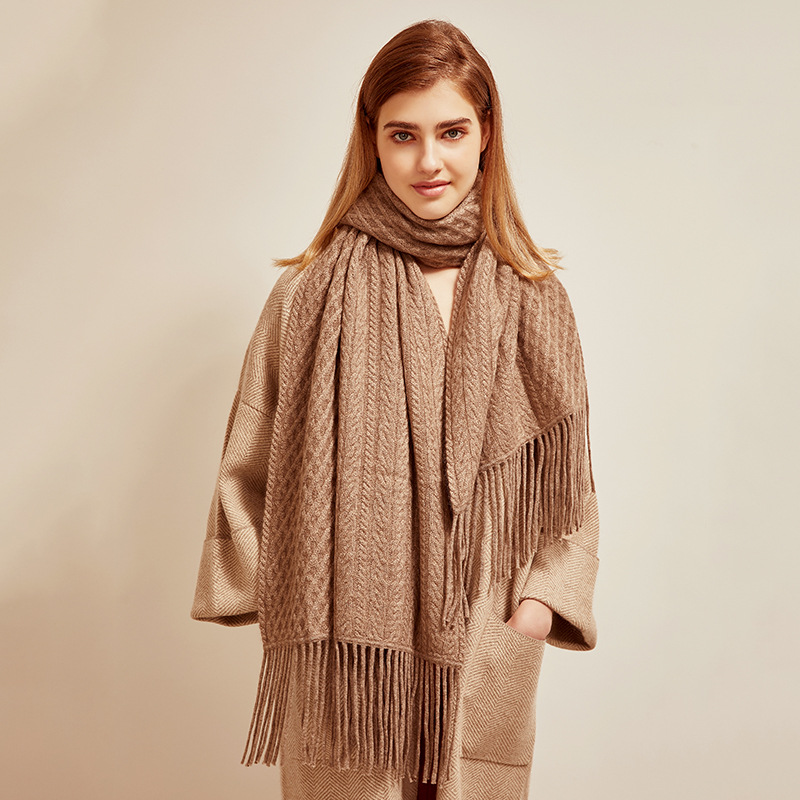
Cashmere scarf ply and knitting gauge determine fabric thickness, warmth, texture, and drape. Lightweight 1-ply or 2-ply yarns suit softer, finer scarves, while 4-ply and 6-ply constructions provide greater weight and warmth. Higher gauges, such as 16GG, create finer knits, while lower gauges, such as 7GG, produce chunkier textures. Choosing the right combination ensures comfort and durability.
Blends vs. 100% Cashmere
100% cashmere scarves offer exceptional softness, warmth, and premium market positioning. Cashmere-silk blends provide a smoother drape and subtle sheen, while cashmere-merino wool blends offer additional structure and cost flexibility. Brands should select fiber compositions based on their target market, product positioning, and budget, ensuring accurate textile labeling.
Logo Options for Branded Cashmere Scarves
Choosing the right cashmere scarf logo customization method helps brands balance visual appeal, fabric comfort, production costs, and minimum order quantities. Common options include jacquard knitting, embroidery, printing, woven labels, and leather patches.
Jacquard Weaving (Integrated Logos)
Jacquard cashmere scarves incorporate logos directly into the knitted fabric using colored yarns, creating a durable and premium appearance. This technique works best for simple, clearly defined patterns but usually requires higher MOQs due to machine programming and yarn preparation.
Embroidery
Custom embroidered cashmere scarves offer flexible logo placement and detailed brand decoration. Small embroidered logos work particularly well near scarf corners or hems. Manufacturers should use appropriate stabilizers and controlled stitching tension to prevent puckering and protect delicate cashmere fibers.
Screen Printing and Digital Printing
Printed cashmere scarves support colorful logos, patterns, and complex artwork. Screen printing suits simpler designs, while suitable digital textile printing methods accommodate detailed graphics. Printing compatibility depends on fabric construction and dyeing technology, so sampling is essential to maintain softness, colorfastness, and drape.
Custom Woven Labels and Leather Patches
Custom woven labels and leather patches provide practical branding options for private-label cashmere scarves. They require minimal changes to the original scarf design and may support lower MOQs when using stock products. Explore our cashmere scarf collection for available styles suitable for customized branding.
How to Make a Complete Cashmere Tech Pack
Design and Dimension Specifications
A detailed cashmere scarf tech pack should specify dimensions, measurement tolerances, yarn composition, and finishing details. Common designs include 180 × 30 cm scarves and oversized 200 × 70 cm wraps. Clearly define fringe lengths, edge styles, and label placement to ensure consistent sampling and production.
Color Matching and Logo Vector Files
Custom cashmere scarf production requires accurate Pantone TCX color references, vector logo files (AI or EPS), and precise branding placement. Include yarn specifications, measurements, and finishing instructions in the tech pack. Clear documentation helps manufacturers achieve consistent colors and accurate logo reproduction.
How to Assess Factories & Suppliers
Selecting a reliable cashmere scarf manufacturer involves evaluating production capabilities, material sourcing, certifications, and communication. Buyers should compare factory experience, sample quality, customization options, and quality control procedures before placing bulk orders.
Verifying Supplier Credentials and Certifications
Cashmere supplier verification should include relevant certifications and sourcing documentation. OEKO-TEX STANDARD 100 addresses harmful substances in certified textile products, while SFA and GCS support responsible cashmere sourcing. Buyers should verify certificate validity and scope before relying on supplier claims.
Red Flags in Supplier Communications
Watch for unusually low prices, unclear fiber origins, limited production evidence, and reluctance to provide independent testing. Reliable cashmere scarf suppliers should offer transparent material specifications, consistent communication, and verifiable manufacturing information to reduce sourcing risks.
White-Label Blanks vs. Fully Custom Manufacturing
White-label cashmere scarves use existing designs with customized labels or logos, offering shorter lead times and lower development costs. Fully custom manufacturing allows unique colors, dimensions, patterns, and branding but requires additional sampling and production time. Explore cashmere scarf styles when comparing product options.
Negotiating Payment Terms and Contracts
Cashmere manufacturing contracts should clearly define deposits, production milestones, quality requirements, and final payment conditions. Linking balance payments to agreed inspections can reduce procurement risks. Buyers should also confirm delivery terms, defect handling, and responsibilities before placing orders.
Understand MOQs and Production Lead Times
Cashmere scarf MOQs and lead times depend on yarn availability, customization complexity, and production volume. Stock designs generally support smaller orders and faster turnaround, while custom dyeing and specialized patterns require additional preparation. Early planning helps brands control costs and meet seasonal deadlines.
Understanding Minimum Order Quantities (MOQs)
Custom cashmere scarf MOQs vary by production method. Stock designs with private labels may allow smaller orders, while custom-dyed or jacquard scarves often require higher quantities due to yarn and machine setup requirements. Buyers should confirm minimums for each color, design, and material before ordering.
Logistics, Customs, and Incoterms
International cashmere scarf shipping requires clear Incoterms, accurate customs documentation, and realistic freight budgeting. FOB and DDP arrangements assign different delivery and import responsibilities. Buyers should verify applicable HS codes, duties, and shipping charges to calculate total landed costs.
Production Timelines and Seasonal Planning
Cashmere scarf production may take approximately 4–8 weeks after sample approval, depending on materials and customization. Dyeing, testing, peak-season demand, and international freight can extend delivery schedules. Brands should plan winter collections well in advance and allow time for unexpected delays.
Sampling, QC and Legal Compliance Workflow
Cashmere scarf quality control involves sample approval, fiber testing, labeling compliance, and packaging inspections. Clear quality standards help manufacturers maintain consistent production and reduce defects. Review our customization and production process for additional information about sampling and manufacturing.
Evaluating the Pre-Production Sample (PPS)
The pre-production sample (PPS) should be checked for dimensions, color accuracy, fabric softness, stretch recovery, and logo quality. Buyers should also inspect stitching, fringes, and labels. Written PPS approval establishes a clear quality reference before bulk production.
Independent Lab Testing
Third-party cashmere testing helps verify fiber composition, fineness, and material authenticity. Laboratories can assess whether products meet declared cashmere percentages and agreed quality specifications. Independent testing provides stronger evidence than visual inspection or traditional burn tests.
Care Labeling and Legal Compliance
Cashmere scarf labels must accurately describe fiber composition, country of origin, and applicable care instructions. For the US market, relevant FTC textile and wool labeling requirements should be considered. Blended scarves must not be marketed as 100% cashmere, and labeling should meet destination-market regulations.
Packaging and Fulfillment Considerations
Cashmere scarf packaging should protect garments from moisture, dirt, and damage during transportation. Options include protective bags, tissue wrapping, and custom gift boxes. Proper packaging supports product presentation and helps ensure scarves arrive in good condition for retail distribution.
Conclusion
Take the following steps to initiate your procurement process:
Audit three to five potential suppliers based on their verifiable GCS or SFA certifications and request their compliance documentation.
Request unbranded, stock samples to evaluate their baseline knitting tension, fiber quality, and edge finishing techniques.
Finalize your comprehensive tech pack, including exact dimensions, Pantone TCX codes, vector artwork, and a detailed Bill of Materials.
Initiate requests for quotes (RFQs) from your shortlisted manufacturers, stating all Incoterms, AQL inspection standards, and lab testing requirements upfront.
FAQ
Q: How do customization methods impact MOQs for custom logo cashmere scarves?
A: Customization methods directly dictate Minimum Order Quantities. Adding custom woven labels to existing stock colors requires minimal setup, allowing for MOQs of 50 to 100 units. Fully custom jacquard weaving or custom yarn dyeing requires the factory to process raw fiber in bulk, pushing MOQs to 300 or 500 units per design.
Q: What is the best way to put a logo on a cashmere scarf?
A: We recommend custom woven labels or debossed leather patches for preserving the fabric's natural softness. Jacquard weaving offers a premium, integrated look for bold designs. We strongly warn against heavy embroidery, as the thread tension often causes fine-gauge knits to pucker and warp.
Q: How can I verify if a scarf is 100% authentic cashmere?
A: While the burn test identifies natural versus synthetic fibers, it cannot differentiate between fine wools. Only microscopic fiber analysis performed by a certified third-party lab, such as SGS or Intertek, can definitively prove fiber purity, origin, and exact micron count.
Q: What is the standard MOQ for custom cashmere scarves?
A: Standard MOQs vary by production type. Fully custom dyed and knit scarves usually require 200 to 500 units per colorway. If you choose to add custom labels or discrete embroidery to pre-manufactured stock colors, factories can often accommodate orders of 50 to 100 units.
Q: How long does it take to manufacture custom cashmere scarves?
A: Expect a standard 30 to 60-day production window after you approve the pre-production sample. This timeframe covers yarn dyeing, knitting, washing, and quality control. You must also add 3 to 5 weeks for sea freight transit and customs clearance.
Q: Can I blend cashmere with wool or silk?
A: Yes, blending alters the fabric's physical properties strategically. Blending with fine merino wool adds structural stability and maintains excellent warmth. A silk-cashmere blend adds a luxurious sheen, increases tensile strength, and reduces overall weight, making it ideal for transitional seasons.
Q: What are the legal labeling requirements for cashmere scarves?
A: International trade laws, including the US Wool Products Labeling Act, require clear, sewn-in disclosure of exact fiber percentages, country of origin, and care instructions. It is strictly prohibited to label any blended textile as "100% Cashmere." Violations trigger severe customs penalties.