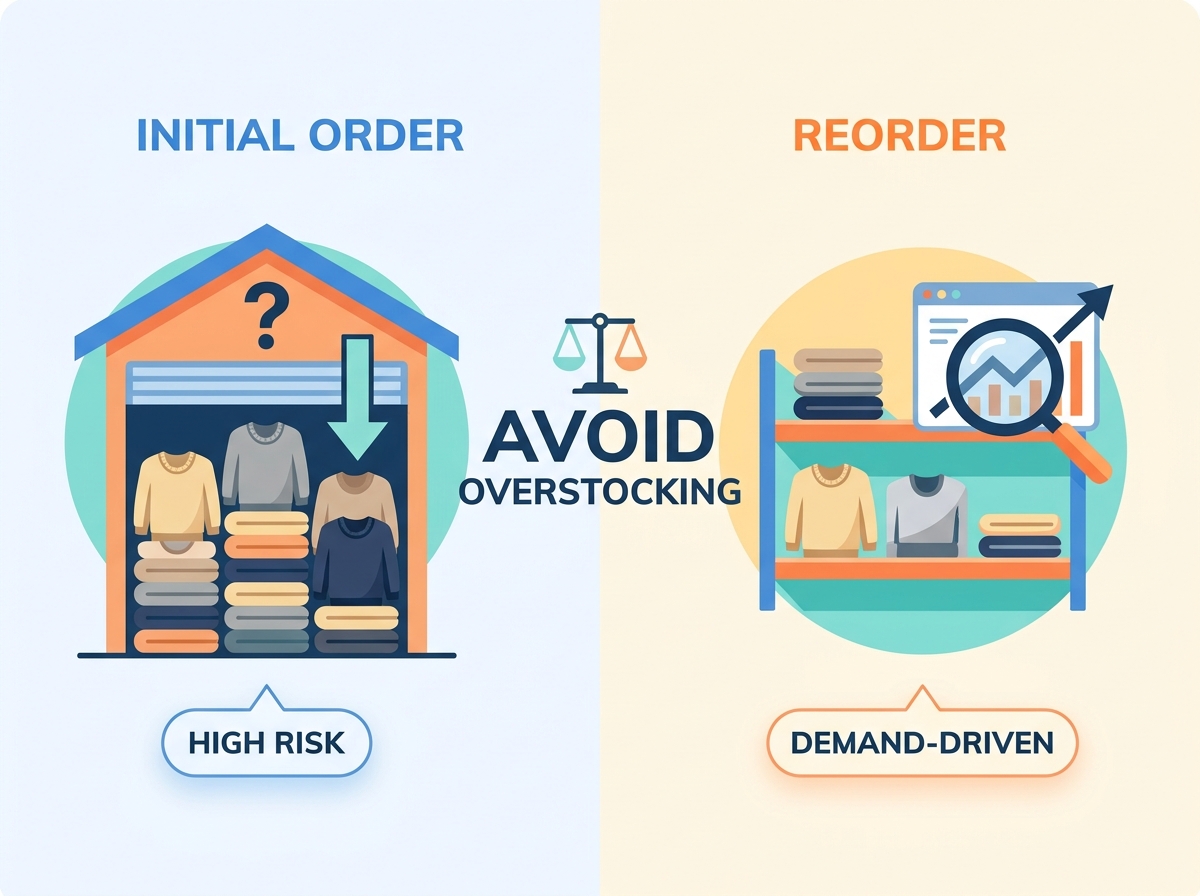
Mismanaging inventory carries severe financial risk, especially when dealing with high-value seasonal apparel. Cashmere requires massive upfront capital, creating a constant tension for buyers and merchandisers on the warehouse floor. Securing enough stock prevents missed peak sales and understocking, but overstocking erodes margins rapidly. Expensive, delicate garments demand specialized storage and tie up liquidity that you could deploy into other fast-moving product lines. This data-driven framework compares initial order strategies with agile reordering protocols. Implementing these steps optimizes inventory turnover, protects your cash flow, and maintains strict product integrity throughout the compressed selling season. We will break down exact formulas for reorder points, outline negotiation tactics for factory minimums, and show you how to stage raw materials to cut lead times in half.
Key Takeaways
Capital Allocation: Initial orders should prioritize baseline historical demand and strict Minimum Order Quantities (MOQs), preserving capital for mid-season reorders based on real-time sales velocity.
Lead Time Realities: Cashmere supply chains require factoring in extended lead times for raw material sourcing (shearing, spinning, dyeing), making accurate reorder points (ROP) critical.
Holding Cost Risks: Overstocked cashmere incurs higher-than-average carrying costs due to specialized warehousing requirements (climate control, pest prevention).
Supplier Flexibility: Transitioning from heavy initial orders to a responsive reorder model requires negotiating flexible terms and utilizing localized safety stock with manufacturing partners.
Automated Safeguards: Leveraging centralized inventory management systems prevents siloed overstocking and automates reorder triggers before stockouts occur.
Table of Contents
Toggle
Why Cashmere Inventory Is More Difficult to Manage
Root Causes of Cashmere Overstocking vs. The Understocking Trap
Inaccurate demand forecasting drives most overstocking errors on the warehouse floor. Buyers often rely on flawed historical data or overestimate seasonal trends based on early runway shows. Factory minimums force larger commitments than necessary. The psychological fear of missing peak-season sales pushes merchandisers to over-order. You want to capture every possible winter sale, but this mindset leads to bloated fulfillment centers by January. Relying on static spreadsheets that fail to account for real-time sales velocity guarantees a surplus of slow-moving units.
Understocking presents an equally dangerous trap. Stockouts during peak months mean lost premium revenue. Customers seeking high-end winter wear will quickly abandon a brand if their size or color is unavailable. This diminishes long-term customer loyalty. Driving traffic to out-of-stock product pages wastes valuable marketing spend. Balancing these two extremes requires precise data rather than gut feeling. You need a system that tracks daily sell-through rates and adjusts procurement schedules dynamically.
High Capital Tie-Up and Margin Implications
Raw Cashmere fiber costs significantly more than synthetic blends or standard wool. The intensive harvesting process dictates this premium. Overstocking directly drains your liquidity and extends your cash conversion cycle. When capital is trapped in slow-moving inventory, you lose the ability to invest in other high-performing SKUs. You cannot pivot to new trends or restock fast-selling core items.
Excess inventory inevitably leads to markdowns. Discounting premium goods severely damages brand equity. Consumers learn to wait for sales rather than paying full price. The cost of these markdowns destroys your profit margins. A twenty percent discount on a high-cost item eliminates the majority of your net profit. Protecting margins means keeping inventory lean and responsive.
Consider the margin erosion timeline for winter apparel:
November: Full margin sales peak as early shoppers secure core sizes.
December: Promotional discounts begin eating into net profit to drive holiday volume.
January: Deep clearance cuts eliminate all margin just to recover raw capital.
February: Dead stock requires liquidation or incurs long-term storage fees.
Shelf-Life, Storage Compliance, and Degradation Risks
Holding excess premium knitwear introduces severe physical risks. Natural fibers attract pests. Moths can destroy an entire pallet of inventory in weeks if left unchecked in a standard facility. Moisture damage causes mold and mildew. Prolonged storage leads to fiber degradation, causing garments to lose their signature softness and structural integrity. These physical risks make long-term storage highly undesirable.
The true carrying cost extends far beyond basic warehouse space. You must factor in climate-controlled environments. Humidity must remain strictly regulated between forty and fifty percent. Specialized insurance policies are necessary to cover high-value goods against pest or water damage. Space constraints in premium fulfillment centers add another layer of overhead. Implementing pheromone traps and cedar lining adds operational complexity to your warehousing procedures.
Storage Requirement
Standard Apparel
Premium Knitwear
Risk of Non-Compliance
Temperature
Ambient
65°F - 70°F
Fiber brittleness
Humidity
Ambient
40% - 50%
Mold, mildew growth
Pest Control
Standard traps
Pheromone traps, cedar lining
Total inventory loss via moths
Packaging
Poly bags
Breathable cotton bags, acid-free tissue
Yellowing, moisture trapping
How to Plan Initial Cashmere Orders Without Overstocking
Calculating Minimum Order Quantities (MOQs) vs. Demand Forecasts
Aligning supplier MOQs with conservative demand forecasts protects your initial capital. Never accept a factory's standard MOQ without analysis. Build a data-driven forecast based on your worst-case sales scenario. If the MOQ exceeds this conservative forecast, you must negotiate or adjust your strategy. Committing to unrealistic volumes guarantees overstocking.
Pooling raw material orders offers a practical solution. You can meet factory MOQs by ordering a large batch of undyed yarn. Allocate this yarn across different styles or colorways. This satisfies the supplier's volume requirement without over-committing to a single finished SKU. It provides flexibility to dye and knit based on actual market reception. Understand the difference between dye lot minimums and spinning minimums to negotiate effectively.
Steps to negotiate MOQs effectively:
Request the factory's raw yarn minimums instead of finished garment minimums.
Offer to pay a slight surcharge for a smaller initial production run to test the market.
Consolidate your color palette to use the same dyed yarn across multiple silhouettes.
Commit to a larger annual volume spread across multiple staggered purchase orders.
Factoring in Production Lead Times
The production timeline dictates your initial order schedule. Raw fiber procurement happens in the spring during the molting season. Scouring, de-hairing, and spinning take place in early summer. Knitting and finishing occur in late summer. Shipping adds several more weeks. This extended timeline forces brands to place initial orders months before the selling season begins.
Long lead times inherently require larger initial orders. You must buffer these estimates using historical supply chain data. Track the actual delivery times from previous years, not just the quoted lead times. Add a two-week buffer for customs delays and transit issues. Differentiate between ocean freight and air freight timelines when calculating your final delivery dates. Accurate lead time mapping prevents panic ordering and ensures stock arrives precisely when demand spikes.
The Role of Historical Data and Trend Analysis
Historical data provides the foundation for initial orders. Focus on previous year's sell-through rates by category and size. Analyze category growth year-over-year. Incorporate macro-economic indicators that influence luxury spending. Consumer confidence indexes and early winter weather forecasts provide valuable context for your initial volume commitments. Always analyze return rates alongside sell-through rates to get a true picture of retained revenue.
Differentiate strictly between core perennial styles and trend-driven seasonal colors. Core items like black or navy crewnecks carry lower risk. Focusing your initial budget on timeless pure cashmere staples ensures consistent sell-through velocity while protecting your gross margins against end-of-season markdowns.. You can safely place larger initial orders for these staples. Trend-driven colors carry high risk. Order the absolute minimum for unproven seasonal hues. Use these smaller quantities to test the market before committing further capital.
How to Reorder Cashmere Without Creating Excess Stock
Setting Accurate Reorder Points (ROP) for Cashmere
The Reorder Point (ROP) formula dictates exactly when to replenish stock. The standard calculation is: (Average Daily Unit Sales x Average Lead Time in Days) + Safety Stock. Calculate your average daily sales using data from peak months, not annual averages. Measure your lead time in days, accounting for raw material availability and transit. Integrate your marketing calendar into the ROP to account for planned promotional spikes.
Adjust the ROP formula specifically for the compressed selling window of winter apparel. The demand curve drops sharply after January. A standard ROP might trigger a massive reorder in late December. This leaves you with dead stock in February. Implement a dynamic ROP that decreases as the season progresses. This prevents late-season overstocking while maximizing early-season availability.
Safety Stock Calculations for High-Value Goods
Safety stock acts as a buffer against unexpected demand spikes or supplier delays. Use a statistical approach to calculate this buffer. Multiply your maximum daily sales by your maximum lead time. Subtract your average daily sales multiplied by your average lead time. This formula provides a mathematically sound safety net based on standard deviation in demand.
Evaluate the trade-off carefully. Holding safety stock incurs carrying costs. Missing premium sales carries a massive opportunity cost. For high-margin items, err slightly on the side of holding safety stock for core sizes and colors. Keep safety stock near zero for fringe sizes and experimental styles. This targeted approach balances risk and reward perfectly.
Just-in-Time (JIT) Feasibility in Cashmere Supply Chains
Applying strict Just-in-Time (JIT) principles to natural fiber manufacturing presents distinct challenges. Raw materials are harvested annually, making true JIT impossible at the fiber level. You can apply JIT principles to the finishing stages. This minimizes on-hand finished inventory while maintaining responsiveness.
Stage undyed yarn or semi-finished greige goods with your suppliers. Sourcing directly from collections crafted with 100% Mongolia cashmere yarns ensures that both initial production and mid-season reorders retain the exact fiber length and ultra-soft hand-feel required for high-end retail. This cuts the reorder turnaround time from months to weeks. It allows you to chase demand accurately without holding massive quantities of finished goods in your own warehouse.
Initial Cashmere Orders vs. Reorders: Which Strategy Works Best?
Volume Discounts vs. Holding Costs
Suppliers often incentivize massive initial orders with attractive volume discounts. This creates a dangerous trap. You must analyze the breakeven point. Calculate the total discount offered. Compare this against the carrying costs, specialized storage fees, and the statistical probability of markdowns. The discount rarely covers the hidden costs of capital and dead inventory.
A ten percent unit cost reduction means nothing if thirty percent of the order requires a half-price markdown in February. Prioritize inventory agility over minor unit cost savings. Paying a slightly higher price for smaller, more frequent batches protects your cash flow and guarantees higher overall profit margins at the end of the season.
Strategy
Primary Advantage
Primary Risk
Best Applied To
Large Initial Order
Lower unit cost, guaranteed early stock
High carrying costs, markdown risk
Core colors, proven perennial styles
Agile Reorder (JIT)
Preserved capital, zero dead stock
Stockouts if lead times fail
Trend colors, new experimental fits
Supplier Contract Structuring for Mid-Season Replenishment
Negotiating smaller reorder minimums requires strategic contract structuring. Do not treat initial orders and reorders as separate transactions. Bundle them during negotiations. Offer a guaranteed annual volume in exchange for flexible, small-batch reorders during the season. Build strong relationships with agile partners who understand seasonal retail dynamics. For boutiques curating refined European and American luxury lines, explore Lanly Cashmere for flexible stocking solutions and premium, retail-ready knitwear.
Utilize capacity booking rather than committing to finished goods upfront. Reserve specific loom and knitting time on the factory floor for November and December. Pay a deposit to hold this production capacity. You dictate the exact styles and colors to be produced just weeks before the booked date based on real-time sales data. Include penalty clauses for missed capacity to ensure the factory honors the reserved time.
Cashmere Inventory Risks and How to Reduce Them
Supply Chain Disruptions in Sourcing
Sourcing raw materials from primary regions like Inner Mongolia involves inherent risks. Geopolitical tensions, severe weather events, and logistical bottlenecks frequently disrupt the supply chain. A harsh winter can decimate goat herds, drastically reducing fiber yield and spiking raw material costs unexpectedly.
Mitigate these risks through strategic diversification. Do not rely on a single manufacturing partner or a single geographic region for spinning and knitting. Hold raw material buffers at the yarn stage. Owning a reserve of undyed yarn insulates you from sudden fiber shortages and allows production to continue even if raw material supply lines freeze.
Technology Stack: Centralization and Automated Safeguards
Managing high-value apparel requires a robust Inventory Management System (IMS). Spreadsheets lead to catastrophic errors. Your IMS must centralize inventory data across all sales channels, including retail stores, wholesale partners, and ecommerce platforms. True omnichannel visibility prevents overselling and siloed overstocking.
Set automated safeguards and ROP alerts within your IMS. Configure the system to trigger purchase order drafts automatically when stock hits the defined threshold. This removes human error and emotion from purchasing decisions. Integrate your Point of Sale (POS) data directly with the IMS via API. Real-time POS integration eliminates the data lag that typically causes reorder miscalculations.
Routine Audits and Cycle Counting
Annual physical inventory counts are insufficient for premium goods. Implement regular cycle counting. Count a subset of your inventory every week. Focus heavily on high-value, fast-moving SKUs using an ABC analysis approach. This continuous auditing process maintains absolute inventory accuracy throughout the chaotic peak season.
Frequent audits catch discrepancies early. They identify missing units, damaged goods, or receiving errors before they impact your reorder formulas. Phantom inventory prevents necessary reorders and masks stockouts. Cycle counting ensures your IMS data matches physical reality perfectly.
Cycle counting best practices:
Assign dedicated staff to count specific aisles daily.
Prioritize counting top-selling SKUs twice a month.
Investigate any discrepancy over two percent immediately.
Update the IMS before the next shipping shift begins.
Conclusion
Audit your current warehouse environment to ensure temperature and humidity controls meet the strict requirements for natural fiber preservation.
Recalculate your Reorder Points using updated, realistic lead times that account for recent supply chain delays and customs processing.
Initiate capacity-booking conversations with your manufacturing partners to secure flexible loom time for mid-season replenishment.
Stage a reserve of undyed yarn with your primary supplier to cut your reorder turnaround time from months to weeks.
Founded in 2009 in Hohhot, Inner Mongolia, Inner Mongolia Field Textile Products Co., Ltd. has developed its business around the region's established cashmere and wool supply base, serving international customers with cashmere and cashmere-blend products. Its product range has expanded from scarves and shawls to knitwear and fashion accessories, allowing brands and buyers to coordinate a broader range of cashmere sourcing and seasonal product requirements with one supplier.
FAQ
Q: What are the primary causes of overstocking in the cashmere apparel industry?
A: Overstocking primarily stems from inaccurate demand forecasting and the psychological fear of stockouts during peak winter months. Brands often yield to supplier minimums, committing to large volumes of unproven seasonal colors instead of relying on data-driven purchasing strategies.
Q: What is the ideal reorder point formula for seasonal cashmere products?
A: The standard formula is (Average Daily Unit Sales x Average Lead Time in Days) + Safety Stock. For seasonal winter apparel, this formula must be dynamic. The ROP should decrease as the season nears its end to prevent late-season shipments that turn into dead stock.
Q: How do production lead times impact initial cashmere orders?
A: Extended production lead times force brands to place orders months in advance. The process of shearing, scouring, spinning, and knitting takes significant time. These long lead times require larger initial orders to ensure sufficient stock is available before the winter selling season begins.
Q: What are the hidden holding costs and space issues of overstocked cashmere inventory?
A: Beyond basic warehouse rent, holding costs include climate control to manage humidity, specialized insurance for high-value goods, and pest prevention measures. Overstocked inventory also consumes valuable shelf space, preventing the intake of fast-moving core items.
Q: How can brands avoid cashmere stockouts without relying on massive initial orders?
A: Brands can avoid stockouts by staging undyed yarn with their suppliers. This allows for rapid dyeing and knitting based on real-time sales data. Negotiating capacity booking rather than finished goods also ensures production space is available for quick mid-season replenishment.
Q: Is Just-in-Time (JIT) inventory management possible for cashmere apparel?
A: True JIT is impossible at the raw fiber level due to annual harvesting cycles. However, JIT principles can be applied to the finishing stages. By holding semi-finished goods or raw yarn, brands can execute rapid, small-batch production runs to meet exact market demand.